


Robots in Industrial Automation: Driving the Future of Australian Manufacturing
Robots in industrial automation helps to define how Australian manufacturing operates. As a result, they are enabling faster production, higher precision, and significantly safer working environments across a wide range of industries.
At Automated Solutions Australia, we actively specialise in the design and integration of FANUC robotic systems that power modern industrial automation solutions across Australia. In practice, this means we help manufacturers move from manual processes to highly efficient automated production environments. From high-volume production lines to precision welding and material handling, robots in industrial automation have become essential infrastructure for competitive manufacturing.
Furthermore, as Industry 4.0 continues to accelerate, Australian manufacturers are increasingly adopting robotic automation. Not only to improve efficiency, but also to remain globally competitive in a rapidly evolving industrial landscape.

Robots in Industrial Automation
Robots in industrial automation are programmable robotic systems that execute repetitive, precise, or hazardous manufacturing tasks with minimal human input. For most cases, they operate continuously, ensuring stable production output.
In addition, these systems are commonly integrated with:
- FANUC robotic controllers
- Machine vision systems
- Industrial sensors and feedback loops
- PLC-based automation systems
- AI-driven production monitoring tools
Robots in industrial automation, undertake manufacturing tasks with unmatched precision. Such tasks include welding, assembly, packaging, inspection, machine tending, and logistics handling. Consequently, manufacturers achieve higher consistency and reduced error rates.
Most importantly, their primary advantage is consistent output at high speed with minimal variation, which is essential in modern manufacturing environments.
FANUC Robotics and Robots in Industrial Automation Throughout Australia
At Automated Solutions Australia, FANUC robots form the backbone of our robots in industrial automation deployments. Because of this, we deliver highly reliable and scalable automation solutions across multiple industries.
FANUC is widely recognised for:
- Industry-leading reliability in continuous production environments
- High precision motion control systems
- Long operational lifespan with minimal downtime
- Strong integration compatibility with factory automation systems
Across Australia, FANUC robotic systems are deployed in:
- Automotive component manufacturing
- Heavy metal fabrication workshops
- Warehousing and logistics centres
- High-speed production environments
As a result, manufacturers can transition from manual or semi-automated processes into fully optimised industrial automation systems. Moreover, this transition significantly improves throughput and operational stability.
Types of robots in industrial automation used in FANUC systems
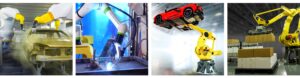
Articulated industrial robots (Powered by FANUC)
FANUC articulated industrial robots feature robotic arms that manufacturers widely deploy for welding, assembly, and heavy-duty manufacturing applications. In fact, across Australian factories, engineers and manufacturers rely on this robot type as one of the most common and versatile solutions for high-volume industrial automation.
SCARA robots in industrial automation
SCARA systems, also available via FANUC, are designed for high-speed, high-precision horizontal movement. Therefore, they are ideal for electronics assembly and small component handling.
Cartesian robots
These robots operate on linear axes (X, Y, Z).
Delta robots
Delta robots are optimised for fast operations.
Collaborative robots in industrial automation
Cobots, also available via FANUC, are designed to safely operate alongside human workers. In turn, this makes them ideal for flexible manufacturing environments and small-to-medium Australian businesses adopting automation.
Key benefits of robots in industrial automation
Increased manufacturing efficiency
Robotics enables continuous production without fatigue. As a result, manufacturers significantly increase throughput across production lines.
Improved product quality and consistency
FANUC robotic systems deliver highly repeatable precision. Therefore, they reduce defects and strengthen overall quality control.
Enhanced workplace safety
Automation reduces human exposure to dangerous tasks such as welding, heavy lifting, and hazardous environments. Consequently, workplace safety improves significantly.
Reduced operational costs over time
Although businesses require an initial investment, they achieve long-term savings through reduced labour costs, fewer errors, and lower downtime.
Scalability for growing manufacturers
In addition, automated systems can be expanded, reprogrammed, or upgraded as production demands change.
Industrial applications of robots in industrial automation in Australia
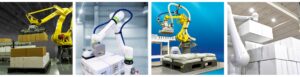
Automotive manufacturing
Manufacturers extensively use robots for welding, assembly, painting, and quality inspection in vehicle production environments. As a result, production speed and consistency improve significantly.
Metal fabrication industry
FANUC robotic welding systems improve weld consistency, speed, and accuracy across repetitive fabrication processes.
Logistics and warehousing
Automation enables efficient sorting, palletising, and material movement in high-volume distribution environments. Furthermore, it reduces handling errors.
Food and beverage manufacturing
Robotic systems improve hygiene standards, packaging speed, and production consistency across regulated environments.
General manufacturing
Across Australian industry, robotic systems modernise aging production systems. Consequently, manufacturers become more competitive and efficient.
AI and smart manufacturing
Modern industrial robotics is no longer purely mechanical. Instead, through AI integration, robots are becoming intelligent production systems.
At Automated Solutions Australia, FANUC systems can support:
- Predictive maintenance to reduce downtime
- Vision-guided quality inspection
- Real-time production monitoring
- Adaptive process optimisation
- Smart factory connectivity across systems
As this evolves, Australian manufacturers are steadily moving toward fully connected Industry 4.0 environments.
Challenges in adopting robots in industrial automation
High upfront investment
Industrial robotics requires initial capital expenditure before ROI is realised. However, long-term savings often significantly outweigh this cost.
Integration with existing systems
Older manufacturing environments may require infrastructure upgrades for full automation compatibility.
Workforce upskilling
Operators and technicians must train to manage and maintain robotic systems. Therefore, workforce development becomes essential.
Ongoing maintenance requirements
Advanced robotics systems require scheduled servicing and technical support to maintain peak performance.
Future of robotics in Australia
The future of robots in industrial automation increasingly focusses on intelligence, autonomy, and connectivity.
Key trends include:
- Expansion of FANUC-powered smart factories
- Greater adoption of collaborative robotics
- AI-driven autonomous production systems
- Cloud-connected manufacturing ecosystems
- Energy-efficient and sustainable automation technologies
Ultimately, Automated Solutions Australia continues to support this evolution by delivering scalable FANUC robotic integration solutions across Australia.
Frequently asked questions
Uses of robots in industrial automation?
Manufacturers use robots in industrial automation for tasks such as welding, assembly, packaging, inspection, and logistics handling.
Why FANUC?
Engineers and manufacturers choose FANUC robots for industrial automation because they deliver reliability, precision, and long-term performance in demanding industrial environments.
Are robots in industrial automation suitable for small businesses?
Yes. Collaborative robots and scalable systems make automation accessible to smaller manufacturers.
What industries benefit most from industrial robotics?
Automotive, metal fabrication, logistics, food production, and general manufacturing all benefit significantly.
