



Manufacturers searching for cobots for welding are looking for a smarter, safer, and more flexible way to automate welding without the complexity of traditional robotic cells. At Automated Solutions Australia (ASA), we design and integrate FANUC collaborative welding robots that allow manufacturers to increase productivity, improve weld quality, and deploy automation faster.
With over 20 years’ experience as FANUC integrators in Australia, ASA helps businesses transition from manual welding to collaborative robotic welding systems that are practical, scalable, and commercially viable.
Cobots for Welding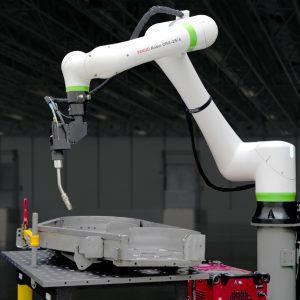
Cobots for welding — also known as collaborative welding robots — are designed to work safely alongside human operators. Unlike conventional industrial robots, welding cobots feature built-in force limiting, advanced sensors, and simplified programming. As a result, they are ideally suited to high-mix, low-volume production environments.
Consequently, manufacturers can automate welding processes without extensive guarding, while still achieving consistent, repeatable weld results.
Why Manufacturers are Adopting Cobots for Welding
Across Australia, manufacturers are increasingly turning to cobots for welding to address labour shortages, rising costs, and inconsistent weld quality. More importantly, collaborative welding automation delivers measurable gains without disrupting existing workflows.
Key advantages include:
- Faster deployment compared to traditional robotic welding cells
- Consistent weld quality and repeatability
- Improved operator safety and reduced fatigue
- Compact footprints ideal for constrained factory layouts
Therefore, cobots for welding represent one of the fastest-return automation investments available today.
FANUC Collaborative Welding Robots
ASA integrates FANUC collaborative robots for welding applications because FANUC delivers unmatched reliability, precision, and long-term support. FANUC cobots are engineered to handle a wide range of welding tasks while maintaining safety and ease of use.
FANUC collaborative welding solutions support:
- MIG welding
- TIG welding
- Arc welding applications
- Small to medium weld assemblies
Because FANUC offers industry-leading motion control and repeatability, manufacturers achieve higher-quality welds with less rework and scrap.
Cobots for Arc Welding Applications
In particular, cobots for arc welding are well suited to manufacturers producing short production runs or frequently changing parts. Rather than reprogramming complex robotic systems, operators can quickly adjust paths and parameters.
As a result, collaborative arc welding robots provide:
- Rapid changeovers
- Reduced setup time
- Consistent penetration and bead appearance
This flexibility allows manufacturers to remain competitive while maintaining tight quality standards.
Collaborative Welding for High-Mix Manufacturing
For high-mix, low-volume production, traditional automation can be difficult to justify. However, cobots remove this barrier by offering intuitive programming and fast redeployment.
Using hand-guided teaching and simplified interfaces, operators can program new weld paths in minutes. Consequently, production teams gain the flexibility to automate more jobs without increasing complexity.

Safety Advantages of Welding Cobots
Safety is a key driver behind the adoption of collaborative welding robots. FANUC cobots incorporate advanced force and speed monitoring, which enables safe operation alongside people.
As a result:
- Extensive safety fencing is often reduced or eliminated
- Operators can load and unload parts more efficiently
- Overall cell footprint is significantly smaller
This makes cobots particularly attractive for small to medium manufacturers.
Cobots vs Traditional Robotic Welding
While traditional robotic welding systems remain ideal for high-volume production, cobots for welding offer distinct advantages in flexible environments.
Compared to conventional robots, welding cobots provide:
- Lower upfront investment
- Faster installation and commissioning
- Easier programming and redeployment
- Greater suitability for variable production
Integrating Cobots for Welding with ASA
As experienced FANUC integrators, ASA manages the full lifecycle of collaborative welding automation — from concept and cell design through to commissioning and ongoing support.
Our integration approach focuses on:
- Maximising weld consistency and repeatability
- Ensuring safe human–robot collaboration
- Delivering fast ROI through practical automation design
Consequently, manufacturers gain a future-ready welding solution that can scale as production grows.
Supporting Applications & Expansion
Cobots for welding often integrate seamlessly with additional automation solutions, including:
Why Choose ASA for Cobots for Welding
Ultimately, choosing the right integrator is just as important as choosing the robot. ASA brings over two decades of experience delivering reliable, production-ready automation across Australia.
When you partner with ASA, you benefit from:
- Proven FANUC expertise
- Application-driven automation design
- Long-term service and support
- Solutions built for real manufacturing environments
Cobots for Welding: Built for Modern Manufacturing
In summary, cobots for welding provide manufacturers with a flexible, safe, and efficient path to welding automation. Whether you are addressing labour shortages, improving weld quality, or increasing output, collaborative welding robots deliver immediate and long-term value.
Speak with Automated Solutions Australia today to explore how FANUC collaborative welding robots can transform your welding operations.