


Introduction to Industrial Manufacturing Robots
Industrial manufacturing robots now sit at the centre of modern production, and manufacturers increasingly rely on them to stay competitive. As global demand for speed, precision, and efficiency rises, companies actively adopt automation in manufacturing to strengthen output and reduce inefficiencies.
In today’s production environments, robotic systems streamline repetitive tasks, enhance safety, and improve consistency. As a result, manufacturers integrate industrial automation solutions not just to improve performance, but to future-proof operations.
Among the most trusted systems, FANUC robotics stands out for reliability, precision, and long-term performance. In this article, we explore how industrial manufacturing robots operate, why they matter, and how ASA implements FANUC robots to deliver advanced manufacturing technology solutions.
What are Industrial Manufacturing Robots?
Industrial manufacturing robots are programmable machines that manufacturers deploy to complete production tasks with high speed and accuracy. These systems actively perform repetitive or complex operations that would otherwise require manual labour.
Typically, manufacturers configure robotic systems for welding, assembly, painting, material handling, packaging, and inspection. By doing so, they improve consistency and reduce variation across production cycles.
Moreover, industrial robots operate continuously without fatigue. Consequently, they maintain stable output levels even in high-demand environments.
Key characteristics include:
- They execute automation in manufacturing with precision
- They maintain high repeatability across production runs
- They operate safely in hazardous environments
- They integrate seamlessly with manufacturing technology systems
Therefore, industrial robots continue to replace manual bottlenecks with scalable automation.

Importance of Industrial Robots in Modern Manufacturing
Industrial robots now drive efficiency across nearly every advanced manufacturing sector. As competition intensifies globally, manufacturers actively adopt robotics to optimise production and reduce waste.
First, robots significantly increase productivity by operating continuously without breaks. In addition, they reduce downtime by performing tasks with consistent accuracy. Furthermore, they eliminate manual errors that typically occur in repetitive workflows.
Equally important, robots enhance workplace safety by taking over dangerous or physically demanding tasks. As a result, manufacturers reduce injury risks and improve compliance with safety standards.
Finally, industrial automation solutions allow businesses to scale operations more effectively while controlling long-term costs. Therefore, robotics has shifted from optional improvement to essential infrastructure in modern manufacturing.
Overview of FANUC Robots
FANUC robots play a major role in global automation in manufacturing. Manufacturers widely adopt them due to their durability, precision engineering, and proven industrial performance.
History and Development of FANUC
FANUC began in Japan as a leader in factory automation and numerical control systems. Over time, the company expanded into robotics and became one of the most recognised names in industrial automation worldwide.
Since its early development, FANUC has continuously refined its robotic systems to meet evolving manufacturing demands. Today, manufacturers across automotive, aerospace, electronics, and heavy industry rely on FANUC robotics to maintain production efficiency and reliability.
Because of this long-standing innovation, FANUC remains a benchmark in manufacturing technology.

Key Features of FANUC Robots
FANUC robotics systems deliver strong performance across demanding industrial environments. Manufacturers choose them because they consistently improve production efficiency and operational stability.
Key features include:
- They deliver high-speed production cycles
- They maintain extreme precision and repeatability
- They handle heavy payloads for industrial applications
- They integrate easily with industrial automation solutions
- They operate with minimal maintenance requirements
- They support long-term durability in continuous production
Therefore, FANUC robots remain a preferred choice for manufacturers seeking reliable automation systems.
Integration of FANUC Robots at ASA
How ASA Implements FANUC Robots
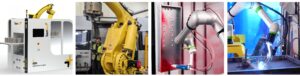
ASA actively integrates FANUC robotics into customised industrial automation systems designed for specific manufacturing needs. Rather than offering generic solutions, ASA engineers tailor each system to match production goals and operational constraints.
First, ASA assesses the manufacturing process. Then, we design the appropriate robotic system based on workload, precision requirements, and workflow structure. After that, ASA configures and programs the system for seamless operation within existing production lines.
Benefits of Integrating FANUC Robots in Manufacturing
When manufacturers integrate FANUC robots, they immediately experience measurable improvements in performance.
For example, production throughput increases because robots operate continuously without fatigue. In addition, product consistency improves due to precise and repeatable movements. Moreover, operational costs decrease as manual labour requirements reduce for repetitive tasks.
At the same time, manufacturers enhance workplace safety by reducing human exposure to hazardous environments.
Consequently, FANUC robotics supports both productivity and long-term operational sustainability.
Applications of Industrial Manufacturing Robots
Common Applications in Various Industries
Industrial manufacturing robots serve a wide range of industries, and manufacturers deploy them to optimise many production processes.
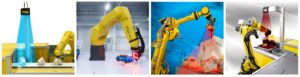
In automotive manufacturing, robots perform welding, assembly, and painting with high precision. Meanwhile, in electronics, they handle delicate component assembly. In addition, packaging and logistics sectors rely heavily on robotic systems for sorting, palletising, and material handling.
Furthermore, metal fabrication industries use robotic systems for cutting, finishing, and surface treatment processes.
Across all industries, automation in manufacturing consistently improves efficiency and reduces operational risk.
Future Trends in Industrial Automation with Robots
As manufacturing continues to evolve, industrial robots will become more intelligent and interconnected.
Increasingly, manufacturers will adopt AI-driven robotics systems that analyse performance in real time. In addition, collaborative robots (cobots) will work alongside human operators to enhance flexibility on production lines.
Moreover, IoT-enabled manufacturing technology will allow robots to communicate across entire factory networks. As a result, manufacturers will gain full visibility and control over production systems.
Finally, predictive maintenance will reduce downtime by identifying issues before they occur.
Therefore, industrial automation solutions will continue evolving toward fully connected smart factories.
Challenges in Adopting Industrial Robots
Potential Challenges for Manufacturers
Despite their benefits, manufacturers often face challenges when adopting industrial robots.
Initially, high upfront investment can slow adoption. In addition, integration with existing systems can create technical complexity. Furthermore, staff must adapt to new workflows and learn new operational skills.
At the same time, manufacturers may experience temporary downtime during installation and commissioning. Finally, ongoing maintenance requires technical expertise.
Because of these factors, some manufacturers hesitate to adopt full automation systems.
How ASA Overcomes These Challenges
ASA actively addresses these challenges through a structured engineering and support approach.
First, ASA designs tailored systems that integrate smoothly into existing production environments. Then, it provides full installation support to minimise disruption. In addition, ASA trains operators to ensure smooth adoption of new systems.
Moreover, ASA offers ongoing maintenance and optimisation services to maintain peak performance. Finally, it designs scalable solutions that grow alongside manufacturing operations.
As a result, manufacturers transition into automation with confidence and minimal operational risk.
Conclusion
Industrial manufacturing robots now form the backbone of modern production environments. As manufacturers face increasing pressure to improve efficiency and reduce costs, robotics delivers a clear and scalable solution.
Through FANUC robotics, manufacturers gain access to reliable, high-performance systems that enhance productivity and consistency. In addition, ASA’s integration of industrial automation solutions ensures these systems operate effectively within real-world manufacturing environments.
Ultimately, as manufacturing continues to evolve, industrial robots will remain central to innovation, efficiency, and long-term industrial success.
