


Automatic Picking is transforming the way manufacturers handle products, components and materials. Instead of relying entirely on operators to repeatedly pick, sort, transfer or place items, manufacturers can use industrial robots to perform these tasks accurately and consistently.
At Automated Solutions Australia (ASA), we integrate FANUC robotic systems into Australian manufacturing environments, helping businesses automate repetitive material handling and picking applications.
From picking components from conveyors to transferring parts between machines, FANUC robots can provide a flexible and reliable solution for modern manufacturing.
What is Automatic Picking?
Automatic Picking is the use of robotic automation to identify, grip and transfer products, components or materials from one location to another.
Depending on the application, a robotic picking system can combine:
- Industrial robots
- Robotic grippers
- Conveyors
- Sensors
- Machine vision
- Control systems
- Part detection
The robot receives information about the location and orientation of an item, moves into position, grips the item and transfers it to the required destination.
As a result, manufacturers can automate repetitive picking processes while maintaining consistent cycle times and reducing manual handling.
FANUC Robots for Automatic Picking
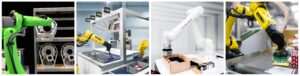
FANUC offers a broad range of industrial robots suitable for material handling and picking applications.
At ASA, we work with FANUC robotic technology to develop and integrate automation systems around the specific requirements of each manufacturing environment.
The right robot depends on several factors, including:
- Payload requirements
- Reach
- Cycle time
- Product size
- Product weight
- Required accuracy
- Available floor space
- Production volume
- Gripper requirements
For example, a compact FANUC robot can be highly effective where space is limited. Meanwhile, larger robots can handle heavier components or greater working envelopes.
This flexibility makes FANUC robots suitable for a wide range of Automatic Picking applications across Australian manufacturing.
How Does Automatic Picking Work?
Although every application is different, a typical robotic picking system follows a straightforward process.
First, products or components are presented to the robot. This might happen on a conveyor, pallet, machine fixture or specialised feeding system.
Next, sensors or machine vision can identify the position of the item.
The FANUC robot then moves to the picking location. A purpose-designed gripper securely picks up the component before the robot transfers it to its destination.
Finally, the robot releases the component and returns to repeat the cycle.
This process can happen continuously throughout production, providing a consistent and repeatable automated workflow.
Automatic Picking and Machine Vision
Some picking applications require more than a fixed robot position.
When products arrive in different positions or orientations, machine vision can help the robotic system determine where and how an item should be picked.
Vision technology can identify characteristics such as:
- Product location
- Product orientation
- Shape
- Size
- Position on a conveyor
- Presence or absence of components
The vision system communicates this information to the robot controller, allowing the FANUC robot to adjust its movement accordingly.
This is particularly useful when products are not presented in exactly the same position during every cycle.
Applications for Automatic Picking
There are many opportunities for robotic picking across Australian manufacturing.
Picking Components from Conveyors
FANUC robots can pick individual components from moving or stationary conveyors and transfer them to another process.
This can be useful for sorting, assembly, packaging and production line automation.
Machine Loading and Unloading
Automatic Picking can also connect different stages of a manufacturing process.
For example, a robot can pick a component, load it into a CNC machine and then remove the finished component once machining is complete.
This creates a connected workflow while reducing repetitive manual handling.

Sorting and Part Handling
Robotic picking systems can identify and sort products according to predetermined requirements.
Components can be separated by type, size, orientation or production stage before being transferred to the next part of the process.
Packaging and End of Line Automation
Picking is also an important part of end of line automation.
A FANUC robot can pick products and place them into packaging, trays, cartons or other containers.
Depending on the application, robotic automation can then be combined with palletising systems to create a highly automated production and packaging process.
What Are the Benefits of Automatic Picking?
For many manufacturers, the biggest opportunity is not simply replacing a manual task with a robot.
Instead, it is about creating a more consistent and connected production process.
Consistent Production
Robots can perform repetitive movements with a high degree of repeatability, helping maintain consistent production cycles.
Increased Productivity
A robotic system can perform repetitive picking tasks continuously throughout production, helping manufacturers increase throughput.
Reduced Repetitive Manual Handling
Picking the same component thousands of times can be repetitive for operators. Automating this process allows people to focus on tasks where human judgement and intervention add greater value.
Improved Material Handling
Robotic picking can reduce manual movement of components between machines, conveyors and production stages.
Better Production Integration
Robots can be integrated with other automation technologies to create a connected manufacturing system rather than an isolated robotic cell.
Designing the Right Robotic Picking System
There is no single Automatic Picking system that suits every manufacturer.
The robot is only one part of the solution.
At ASA, we look at the complete application. That includes the product being handled, how it arrives at the picking point, the required cycle time, the required grip, the destination and how the robot needs to communicate with the rest of the production system.
The gripper is particularly important.
Different products require different approaches to handling. Depending on the component, this could involve mechanical gripping, vacuum technology or another specialised end of arm tooling solution.
The system may also require conveyors, sensors, safety equipment, vision systems and PLC controls.
By considering the complete application, manufacturers can develop an automation solution that works as part of their existing production environment.
Automatic Picking for Australian Manufacturing
Australian manufacturers operate in a competitive environment where productivity, consistency and efficient use of labour are increasingly important.
Robotic automation can provide an opportunity to improve repetitive processes while creating a more streamlined production environment.
However, successful automation requires more than simply installing a robot.
It requires careful consideration of the complete process.
That is where systems integration becomes important.
At Automated Solutions Australia, we integrate FANUC robots into manufacturing applications across Australia. Our focus is on developing robotic automation solutions around the requirements of each customer and production environment.
From Automatic Picking and material handling through to machine tending, welding, palletising and automated paint applications, FANUC robots can be integrated into a wide range of industrial processes.
Why Choose ASA for FANUC Robotic Integration?
ASA brings together robotic technology, automation knowledge and practical systems integration.
We work with FANUC robots to develop solutions that can be integrated with existing machinery and production processes.
Our approach starts with the application rather than simply selecting a robot.
We consider what needs to be picked, how quickly it needs to be picked, where it needs to go and what other equipment needs to communicate with the robotic system.
The result is a robotic solution designed around the manufacturing process.
For Australian businesses investigating Automatic Picking, robotic picking can be an important step towards greater production automation.
With the right FANUC robot, tooling and integration strategy, repetitive picking tasks can become a reliable and highly repeatable part of the manufacturing process.
Take the Next Step with Automatic Picking
If your manufacturing process involves repetitive picking, sorting, transferring or handling of components, robotic automation could provide an opportunity to improve the way the process operates.
At Automated Solutions Australia, we can assess the application and determine how FANUC robotic technology could be integrated into your production environment.
Looking at Automatic Picking for your Australian manufacturing operation? Talk to Automated Solutions Australia about integrating a FANUC robotic solution around your application.
1800 ROBOTS
sales@automatedsolutions.com.au