


Smart Manufacturing: How Robotics and Automation are Transforming Australian Industry
Manufacturing is moving forward fast.
Across Australia, manufacturers are looking for smarter ways to increase productivity, improve quality and compete in an increasingly demanding market. At the same time, businesses face rising operating costs, skills shortages and growing pressure to produce more while using resources more efficiently.
That is where smart manufacturing makes a real difference.
Smart manufacturing brings together industrial automation, robotics, connected machinery, data and intelligent technologies to create more efficient production environments. Instead of relying on isolated machines and repetitive manual processes, manufacturers connect their equipment and automate key stages of production.
As a result, they can create faster, more consistent and more responsive manufacturing operations.
However, smart manufacturing is about much more than simply installing a robot.
It is about connecting technology with the way a business actually manufactures products.
At Automated Solutions Australia (ASA), we help Australian manufacturers take that step by integrating advanced automation solutions, including FANUC robots, into practical manufacturing applications.
What is Smart Manufacturing?
Smart manufacturing uses connected technology, automation, robotics and production data to improve manufacturing processes.
Traditional manufacturing often separates individual production tasks. One machine performs one operation, an operator moves the component, another machine completes the next stage, and employees manually inspect the finished product.
Smart manufacturing takes a different approach.
Instead, manufacturers connect these processes and automate where it makes sense.
For example, a manufacturer could use a FANUC industrial robot to load components into a CNC machine. Once machining finishes, the robot removes the completed component and moves it to the next production stage.
At the same time, sensors and control systems can collect information about the process.
Therefore, the manufacturer gains more than automation. They gain a connected production system.
Smart manufacturing can bring together:
- Industrial robots
- Manufacturing automation
- CNC automation
- Machine monitoring
- Sensors
- Machine vision
- Automated inspection
- Robotic material handling
- Production data
- Industrial control systems
- Connected machinery
Together, these technologies create a more intelligent approach to production.
How Does Smart Manufacturing Work?
Smart manufacturing connects the different parts of a production environment so they can work together.
Instead of allowing machines, robots and operators to function in isolation, manufacturers can build integrated manufacturing systems.
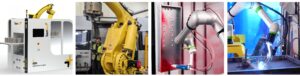
For example, one automated production cell might combine a:
CNC machine + FANUC robot + vision system + sensors + control system
Each component performs a specific job. However, the real advantage comes from connecting those jobs.
The CNC machine processes the component.
The FANUC robot loads and unloads it.
A vision system can inspect it.
Sensors can monitor the process.
Meanwhile, the control system coordinates the operation.
As a result, the production cell becomes more efficient and easier to manage.
Moreover, manufacturers can use production information to identify bottlenecks, improve workflows and make better decisions.
That is the real strength of smart manufacturing. It connects automation with information.
The Role of Industrial Robots in Smart Manufacturing
Industrial robots sit at the heart of many modern smart manufacturing systems.
Why?
Because robots can perform repetitive tasks quickly, accurately and consistently.
They can also work alongside other automated equipment. Therefore, manufacturers can integrate robotics into larger production systems rather than treating a robot as a standalone machine.
At ASA, we integrate FANUC robots into manufacturing applications across Australia.
Our team looks at the entire process first. Then, we determine where robotics can create the greatest impact.
That might mean automating machine tending.
It could involve robotic welding.
Alternatively, the opportunity might sit in palletising, material handling, inspection or another repetitive production process.
By focusing on the application, rather than simply the robot, manufacturers can build automation that delivers a practical result.

How FANUC Robots Support Smart Manufacturing
FANUC provides a broad range of industrial robots and automation technologies for manufacturing environments.
At ASA, we integrate FANUC robots into automated systems designed around specific production requirements.
That flexibility makes FANUC technology particularly valuable for smart manufacturing applications.
For example, a manufacturer might use a FANUC robot to:
- Load and unload CNC machines
- Move components between production stages
- Palletise finished products
- Perform robotic welding
- Handle materials
- Support automated inspection
- Pick and place components
- Automate repetitive production tasks
- Support paint finishing applications
More importantly, these robots can form part of a much larger automated system.
Therefore, manufacturers can move beyond simple robotic automation and develop integrated robotic manufacturing cells.
Smart Manufacturing and CNC Machine Automation
CNC machines already automate a major part of the machining process.
However, the surrounding tasks often remain manual.
An operator may still need to load a component, start the cycle, remove the finished part and repeat the process throughout the day.
That creates a clear opportunity for automation.
With CNC machine tending, a FANUC robot can take over repetitive loading and unloading tasks.
The robot picks up the component, positions it in the machine, waits for the machining cycle and then removes the completed part.
Consequently, the manufacturer can create a smoother and more automated production workflow.
At the same time, operators can spend less time performing repetitive handling tasks and more time managing higher-value activities.
CNC automation can therefore help manufacturers improve:
- Machine utilisation
- Production consistency
- Throughput
- Labour efficiency
- Workplace safety
- Production capacity
Furthermore, manufacturers can integrate additional automation as their needs grow.
That makes CNC machine tending an excellent starting point for businesses beginning their smart manufacturing journey.
Robotic Welding Creates More Consistent Production
Welding demands precision.
It also requires skilled operators who can maintain consistent weld quality throughout production.
However, repetitive welding tasks can become physically demanding. They can also create production challenges when businesses struggle to find enough skilled workers.
Robotic welding provides another approach.
A FANUC welding robot follows programmed movements and weld paths with high repeatability. Consequently, manufacturers can automate suitable welding applications while maintaining consistent production.
At ASA, we design and integrate robotic welding systems around the specific application.
That means we consider the component, welding process, production volume, workspace and required cycle time before developing the solution.
As a result, the robotic system works as part of the production process rather than simply sitting beside it.
Robotic Palletising Streamlines Material Handling
Manufacturing does not stop when a product leaves the production machine.
Someone still needs to move, stack and prepare those products for the next stage.
For many businesses, this creates another opportunity for smart automation.
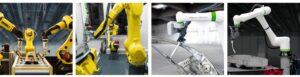
Robotic palletising allows a robot to automatically pick products from a conveyor or production line and arrange them onto pallets.
Instead of repeatedly lifting and positioning products manually, the robot handles the repetitive movement.
This can reduce manual handling while increasing production consistency.
Similarly, robotic material handling systems can transfer components between machines and production stages.
Therefore, manufacturers can create a more continuous production flow.
And because the robot handles repetitive movement, employees can focus their time and skills elsewhere.
Automated Inspection Strengthens Quality Control
Quality matters at every stage of manufacturing.
However, manually checking every component can consume valuable time.
Automated inspection provides another way to approach quality control.
Manufacturers can integrate robots, cameras, sensors and inspection equipment to automate specific inspection tasks.
For example, a robotic inspection system can position a component accurately, move inspection equipment around it and capture consistent measurements or images.
As a result, manufacturers can create a more repeatable inspection process.
Furthermore, connecting inspection systems to a wider manufacturing environment can provide valuable production information.
Instead of simply discovering a quality issue at the end of production, manufacturers can identify patterns earlier and respond more quickly.
That shift from reactive quality control to proactive process improvement represents an important part of smart manufacturing.
What Are the Benefits of Smart Manufacturing?
Increase Production Efficiency
Automation allows manufacturers to streamline repetitive processes.
Robots can perform programmed tasks consistently, while automated equipment can keep production moving.
As a result, businesses can improve throughput and make better use of their production assets.
Improve Consistency
Humans remain essential to manufacturing.
However, repetitive tasks can introduce variation over time.
Robotic automation delivers repeatable movements and processes. Therefore, manufacturers can improve consistency across suitable applications.
Reduce Repetitive Manual Work
Employees do not need to spend their entire day performing the same repetitive movement.
Instead, manufacturers can automate suitable tasks and allow employees to focus on supervision, quality, maintenance and problem-solving.
Improve Workplace Safety
Some manufacturing tasks involve repetitive lifting, awkward movements or potentially hazardous environments.
Automation can move people away from certain tasks and allow robots to handle suitable high-risk or physically demanding processes.
Support Future Growth
Production volumes change. Products change. Customer requirements change.
Fortunately, modern robotic automation can provide flexibility that helps businesses adapt.
Smart Manufacturing vs Traditional Manufacturing
The difference between traditional and smart manufacturing goes beyond simply replacing people with robots.
Instead, smart manufacturing focuses on integration, connectivity and intelligent use of production information.
| Traditional Manufacturing | Smart Manufacturing |
|---|---|
| Manual material handling | Robotic material handling |
| Standalone equipment | Connected equipment |
| Manual production monitoring | Automated monitoring |
| Manual inspection | Automated inspection |
| Isolated automation | Integrated robotic systems |
| Reactive processes | Data-informed decisions |
| Repetitive manual tasks | Automated workflows |
However, manufacturers do not need to completely abandon existing processes.
In fact, many businesses can start small.
They can identify one repetitive or inefficient process, automate it and then build from there.
Does Smart Manufacturing Require a New Factory?
No.
This is an important point.
Smart manufacturing does not necessarily mean demolishing an existing factory and starting again.
Instead, manufacturers can progressively introduce automation into their current operations.
For example, a business could begin with CNC machine tending.
Once that system proves successful, the manufacturer could automate material handling.
Next, they might introduce robotic inspection or palletising.
Over time, these individual systems can become part of a much more connected manufacturing environment.
Therefore, businesses can build their smart manufacturing capabilities step by step.
This approach can make automation more practical, manageable and aligned with business goals.

Smart Manufacturing for Australian Manufacturers
Australian manufacturers operate in a competitive environment.
At the same time, businesses need to manage costs, improve productivity and respond to changing customer expectations.
Consequently, automation has become an increasingly important part of modern manufacturing strategy.
However, successful automation starts with the production process.
Before selecting a robot, manufacturers need to understand:
- What task needs automating?
- How often does it occur?
- What cycle time does the process require?
- What components will the system handle?
- How much floor space is available?
- How will the robot interact with existing machinery?
- What safety requirements apply?
- What production volumes are expected?
- Could the system expand in the future?
Once these questions have been answered, an automation integrator can design the right solution.
That is where ASA comes in.
Why Choose ASA for Smart Manufacturing?
At Automated Solutions Australia, we do more than supply industrial robots.
We design and integrate automation systems around real manufacturing challenges.
Our team works with manufacturers to identify opportunities, develop practical robotic solutions and integrate those systems into existing production environments.
FANUC robotics plays a major role in that capability.
From CNC machine tending and robotic welding to palletising, material handling and automated inspection, we integrate FANUC robots into applications designed to improve manufacturing performance.
Most importantly, we focus on the complete system.
We consider the robot, machinery, tooling, controls, safety requirements and production workflow.
As a result, manufacturers receive an integrated automation solution rather than a standalone piece of equipment.
Make Your Manufacturing Smarter with ASA
Smart manufacturing is no longer just a concept for the future.
Australian manufacturers are already using industrial robotics, automation and connected technologies to improve the way they produce, handle and inspect products.
And you do not have to automate everything at once.
Start with the process that creates the biggest opportunity.
Then build from there.
At Automated Solutions Australia, we help manufacturers identify those opportunities and develop automation solutions around them. By combining our integration expertise with FANUC robotic technology, we can help businesses take practical steps towards smarter, more efficient manufacturing.
Ready to explore smart manufacturing for your business? Contact ASA to discuss your next industrial automation project.

Send an Enquiry: