



Transforming Australian Manufacturing Through Automated Handling
Manufacturing is changing rapidly. Across Australia, businesses are looking for smarter ways to increase productivity, improve consistency and remain competitive. As production demands grow and skilled labour becomes increasingly important, automated handling is becoming an essential part of modern manufacturing.
At Automated Solutions Australia (ASA), we help Australian manufacturers embrace this change through the integration of advanced FANUC industrial robots and collaborative robots. Our automated handling systems are designed to move, position, load, unload, transfer and manage products and components with precision and repeatability.
From robotic machine tending and pick and place applications to automated palletising and heavy-duty material handling, FANUC robots provide manufacturers with flexible automation options across a wide range of industries.
However, successful automation involves more than simply installing a robot. It requires careful engineering, application knowledge and seamless integration with existing production equipment.
This is where ASA makes the difference.
With more than 20 years of experience integrating FANUC robotics, our team delivers complete automated handling solutions, from initial concept and system design through to installation, programming, commissioning and ongoing support.
What Is Automated Handling?
Automated handling refers to the use of robotic systems and automated equipment to move, position, load, unload and transfer materials or products throughout a manufacturing or production environment.
Instead of relying entirely on manual handling, manufacturers can integrate industrial robots to perform repetitive, physically demanding or highly precise movements.
These systems can operate independently or communicate with other production equipment to create a connected manufacturing process.
For example, an automated handling system may use a FANUC robot to collect a component from a conveyor, position it inside a CNC machine, remove the finished part and transfer it to the next production stage.
Similarly, a robotic palletising system can collect finished products and arrange them into consistent pallet loads ready for storage or distribution.
Automated handling can incorporate several technologies, including:
- FANUC industrial robots and collaborative robots.
- Robotic grippers and end-of-arm tooling.
- Conveyor systems and automated transfer equipment.
- Machine vision and robotic inspection.
- Programmable Logic Controllers (PLCs).
- Sensors, safety equipment and machine interfaces.
- Automated loading and unloading systems.
When these technologies work together, manufacturers can create a more efficient, consistent and connected production environment.
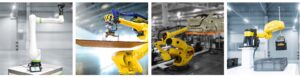
Why Are FANUC Robots Ideal for Automated Handling?
Choosing the right robot is essential to achieving successful automation.
At ASA, we integrate FANUC industrial robots because their extensive range provides solutions for applications requiring different payload capacities, reach, speed, accuracy and operating configurations.
Whether a manufacturer needs a compact robot for handling small components or a heavy-duty industrial robot for moving substantial loads, FANUC offers a broad selection of robotic technologies.
Importantly, the right robot depends on the application.
For instance, a high-speed pick and place operation has different requirements from heavy-duty material transfer. Likewise, a CNC machine tending application requires careful consideration of machine access, tooling and production cycle times.
FANUC robotic technology can support:
- High-speed component handling.
- Precision pick and place operations.
- Automated loading and unloading.
- Robotic palletising and depalletising.
- Heavy-duty industrial material handling.
- Automated packaging and assembly.
- Machine tending and production transfer.
At ASA, we assess the manufacturing process before selecting the appropriate FANUC robot and designing the complete automated handling system.
Key Applications of Automated Handling in Australian Manufacturing
Automated handling is not limited to one industry or production process. In fact, FANUC robots can be integrated across numerous manufacturing applications, helping businesses automate individual tasks or connect multiple stages of production.
1. Robotic Machine Tool Tending
Machine tool tending is one of the most valuable applications of automated handling.
CNC machines, lathes and milling machines often require operators to load raw components, remove finished parts and repeat the process throughout production.
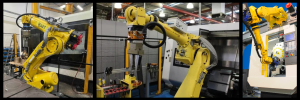
By integrating a FANUC machine tending robot, manufacturers can automate these repetitive movements.
The robot can collect components, load them into the machine, remove completed parts and transfer them to designated locations.
This helps reduce manual intervention while allowing CNC machinery to operate more consistently.
Automated machine tending can also support extended production hours and unattended manufacturing, depending on the application and system design.
At ASA, we design and integrate robotic machine tending systems to help manufacturers maximise machine utilisation and improve production efficiency.
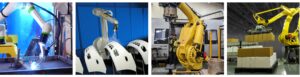
2. Robotic Palletising and Depalletising
Moving finished products and materials can be physically demanding, particularly in high-volume manufacturing environments.
Robotic palletising provides an automated solution.
FANUC palletising robots can pick up individual products, cartons, bags, drums and other materials before arranging them into predetermined pallet patterns.
Similarly, depalletising robots can remove products from incoming pallets and transfer them into production processes.
The benefits include:
- Reduced repetitive manual lifting.
- Consistent pallet configurations.
- Improved production throughput.
- More efficient end-of-line operations.
- Greater flexibility across product types.
- Improved workplace safety.
FANUC offers dedicated palletising robots designed to handle a wide range of payloads and production requirements.
ASA integrates complete robotic palletising systems to help Australian manufacturers streamline packaging, handling and end-of-line operations.
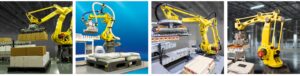
3. Automated Pick and Place Systems
Pick and place automation involves identifying, collecting and positioning components or products from one location to another.
Although this sounds straightforward, these operations can be repetitive and time-consuming when performed manually.
FANUC robots can automate pick and place applications with programmed movements and consistent positioning.
Depending on the application, systems can incorporate robotic grippers, conveyors, sensors and vision technology to identify and handle components.
Common applications include:
- Component sorting and positioning.
- Product transfer between production stations.
- Automated assembly feeding.
- Packaging operations.
- Product orientation and placement.
- Parts handling and distribution.
Furthermore, robotic vision can help identify component positions and support applications where products arrive in varying orientations.
As a result, manufacturers can improve handling consistency and reduce repetitive manual tasks.
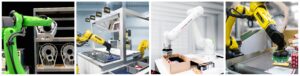
4. Automated Material Handling and Transfer
Material handling is an essential part of almost every manufacturing operation.
Components frequently need to move between machinery, production stations, conveyors, storage areas and assembly processes.
When these movements rely entirely on manual labour, they can create production bottlenecks and place additional demands on operators.
FANUC material handling robots can automate these transfers, helping manufacturers maintain a more consistent flow of materials throughout their facilities.
Depending on the application, a robotic system can handle individual components, larger assemblies or heavy industrial materials.
FANUC provides a broad range of material handling robots, including compact models and heavy-duty systems. Its published material handling range spans payloads from 0.5 kg to 2,300 kg, depending on the robot model.
Consequently, manufacturers have access to robotic solutions for applications ranging from delicate component handling to demanding heavy-duty operations.
At ASA, we integrate the robot with the necessary tooling, conveyors, machinery and control systems to create a complete automated handling solution.
5. Automated Assembly and Production Handling
Assembly operations frequently involve repetitive movements, component placement and precise positioning.
FANUC robots can automate selected assembly and handling tasks, helping manufacturers achieve repeatable movements throughout production.
For example, robots can transfer components between workstations, position parts for assembly or supply products to downstream processes.
Additionally, collaborative robots can provide flexible automation options for suitable applications where people and robots need to work in close proximity.
The appropriate system depends on the task, tooling, risk assessment and required production outcome.
By integrating robotic handling into assembly operations, manufacturers can improve process consistency and reduce repetitive manual work.
The Benefits of Automated Handling for Australian Manufacturers
Investing in automated handling is about more than replacing manual movements. It is about improving the performance of the entire manufacturing process.
When correctly designed and integrated, FANUC robotic systems can deliver several operational advantages.
Increased Productivity and Throughput
Robots can perform repetitive handling tasks consistently throughout production.
As a result, manufacturers can reduce interruptions associated with manual loading, unloading and material transfer.
Furthermore, automated handling can help production equipment operate for longer periods, depending on the system configuration.
Improved Accuracy and Repeatability
Consistent positioning is essential in many manufacturing applications.
FANUC robots follow programmed movements, helping ensure components are handled and positioned consistently.
Consequently, manufacturers can improve process repeatability and reduce errors associated with manual handling.
Reduced Manual Handling
Repetitive lifting, transferring and positioning can place physical demands on manufacturing employees.
Automated handling allows suitable robotic systems to undertake these tasks, reducing operator exposure to repetitive and physically demanding activities.
This can contribute to improved workplace ergonomics and safety.
Greater Manufacturing Flexibility
Modern manufacturers often work with different products, component sizes and production requirements.
Robotic handling systems can be designed with appropriate tooling, programming and production interfaces to accommodate different parts and processes.
Therefore, manufacturers can adapt their automation systems as production requirements change.
Improved Production Efficiency
Automating repetitive material movements can help reduce unnecessary handling time and production bottlenecks.
In turn, this allows manufacturers to make better use of machinery, labour and available production space.
Potential for Unattended Manufacturing
Depending on the application, robotic handling systems can support extended or unattended production.
For example, a FANUC robot integrated with a CNC machine can load and unload components as part of an automated production sequence.
This creates opportunities for longer operating hours and improved machine utilisation.
Choosing the Right FANUC Robot for Automated Handling
Not every manufacturing application requires the same robot.
Selecting the right FANUC robot involves assessing several important factors.
Payload capacity: How much does the component or product weigh? The robot must accommodate the combined weight of the product, gripper and any additional tooling.
Reach: The robot must access all required positions within the production cell, including machinery, conveyors and transfer points.
Cycle time: How quickly must the robot complete each movement? Production targets and machine operating speeds help determine the required performance.
Accuracy and repeatability: Some applications require particularly precise positioning, especially when loading components into CNC machines or placing parts during assembly.
Operating environment: Dust, heat, moisture and other environmental conditions can influence robot selection and system design.
End-of-arm tooling: Grippers, vacuum systems and specialist tooling must be selected to suit the components being handled.
Safety and integration: The robotic system must communicate with surrounding machinery and incorporate suitable safety measures for the operating environment.
At ASA, we consider these requirements during the initial design and engineering process.
Rather than simply selecting a robot and fitting it into a production line, we develop an integrated solution around the manufacturer’s specific application.
Why Choose Automated Solutions Australia for FANUC Automated Handling?
Successful automation requires more than advanced robotic equipment. It requires engineering knowledge, practical manufacturing experience and an understanding of how different systems work together.
At Automated Solutions Australia, we specialise in the design, integration and installation of FANUC industrial robots and collaborative robots for Australian manufacturers.
We have been integrating FANUC robots since 2002, supporting businesses across a broad range of manufacturing industries.
Our engineering team includes control engineers, process engineers, mechanical and electrical designers, and robotic programmers.
This multidisciplinary approach allows us to support projects from initial concept through to completed robotic integration.
Our capabilities include:
- Application assessment and needs analysis.
- Robotic system design and concept development.
- FANUC robot selection.
- Mechanical and electrical engineering.
- Robotic programming and integration.
- PLC and control system integration.
- Installation and commissioning.
- Operator training.
- Robot servicing and ongoing support.
Importantly, our work is not limited to standalone handling robots.
We integrate FANUC technology into complete manufacturing systems, bringing together machinery, conveyors, tooling, controls and safety equipment to achieve the required production outcome.
Whether you are looking to automate a single handling process or introduce a more comprehensive robotic solution, ASA can help identify the right approach.
The Future of Automated Handling in Australian Manufacturing
As Australian manufacturing continues to evolve, automation will play an increasingly important role in improving production capability.
Manufacturers are looking for ways to increase throughput, manage labour requirements, improve workplace safety and maintain consistent product quality.
Automated handling provides opportunities to address these challenges.
Furthermore, advances in robotics, machine vision, collaborative technology and integrated control systems are creating new possibilities for flexible manufacturing.
Rather than automating every process at once, businesses can start with individual applications that deliver measurable operational improvements.
For example, automating CNC machine loading or introducing robotic palletising can provide a practical starting point for manufacturers looking to expand their automation capabilities.
Over time, additional robotic systems can be integrated to connect production processes and create more efficient manufacturing environments.
At Automated Solutions Australia, we believe the future of Australian manufacturing is built on intelligent automation, practical engineering and the right robotic technology.
With FANUC at the centre of our integration capabilities, we help Australian businesses take the next step towards smarter, more productive manufacturing.
Frequently Asked Questions About Automated Handling
What is automated handling in manufacturing?
Automated handling uses robots and automated equipment to move, position, load, unload and transfer materials or products throughout a manufacturing process. FANUC robots can automate applications such as machine tending, pick and place, palletising, packaging and material transfer.
What are FANUC automated handling robots used for?
FANUC robots are used for a wide range of handling applications, including component transfer, CNC machine loading and unloading, robotic palletising, depalletising, pick and place, packaging and assembly. The appropriate robot depends on the payload, reach, speed and requirements of the application.
What are the benefits of automated handling systems?
Automated handling systems can improve productivity, increase process consistency, reduce repetitive manual handling, improve production efficiency and support extended operating hours. They can also help manufacturers reduce bottlenecks and improve the flow of materials throughout production.
Can automated handling be integrated into existing machinery?
Yes. Robotic handling systems can be integrated with existing CNC machines, conveyors, production equipment and other manufacturing machinery. However, the design must account for machine interfaces, tooling, programming, safety and production requirements.
Can FANUC robots handle heavy materials?
Yes. FANUC offers industrial robots across a broad range of payload capacities, including heavy-duty models designed for demanding material handling applications. The correct robot must be selected according to the component weight, tooling, reach and operating requirements.
Is automated handling suitable for small and medium-sized manufacturers?
Yes. Automated handling is not limited to large manufacturing facilities. Compact robotic systems and collaborative robots can provide automation opportunities for smaller operations, particularly where repetitive handling tasks, machine loading or packaging create production bottlenecks.
Why use an experienced FANUC robot integrator?
An experienced robot integrator can assess the application, select suitable robotic technology and engineer the complete system. This includes tooling, controls, machinery interfaces, safety systems, programming, installation and commissioning. ASA provides this integration expertise to Australian manufacturers.
Talk to ASA About Automated Handling
Are repetitive handling tasks slowing down your production? Are you looking to improve machine utilisation, reduce manual handling or increase manufacturing throughput?
Automated Solutions Australia can help.
As an experienced FANUC robot integrator, we work with Australian manufacturers to develop automated handling systems tailored to their production requirements.
From robotic machine tending and pick and place to palletising, component transfer and heavy-duty material handling, our team can help you identify the right FANUC robotic solution.
With support from initial concept and engineering through to installation, programming, commissioning and ongoing service, ASA is your partner in industrial robotic automation.
Let’s make your next manufacturing improvement a reality.
Contact Automated Solutions Australia today.
1800 ROBOTS (1800 762 687)