


Industrial robots have transformed manufacturing across the globe, helping businesses improve productivity, enhance quality, and create safer workplaces. As industries continue to embrace automation, the application of industrial robots has expanded well beyond traditional automotive production lines. Today, robots perform a wide variety of tasks in sectors ranging from food manufacturing and mining to pharmaceuticals and metal fabrication.
Advances in robotics, artificial intelligence, machine vision and automation technology have made industrial robots more capable, flexible and cost-effective than ever before. Businesses of all sizes are now recognising the value of investing in robotic automation to remain competitive in an increasingly demanding marketplace.
Whether a robot is welding, loading CNC machines, palletising products or performing quality inspections, the goal remains the same, to deliver greater efficiency, improve consistency and reduce operational costs.
In this guide, we’ll explore the many applications of industrial robots, the industries that rely on them, the benefits they provide, and how Australian manufacturers can successfully implement robotic automation.
What Are Industrial Robots?
Industrial robots are programmable machines designed to automate repetitive, physically demanding or high-precision manufacturing tasks. Unlike conventional machinery, industrial robots can often be reprogrammed to perform different operations, making them one of the most flexible automation technologies available.
Modern industrial robots feature advanced motion control, integrated sensors, vision systems and intelligent software that enable them to perform complex manufacturing processes with exceptional speed and accuracy.
The application of industrial robots continues to evolve as manufacturers seek smarter ways to improve production efficiency while maintaining high quality standards.
Why the Application of Industrial Robots Is Growing
Australian manufacturers face increasing pressure to produce more while controlling costs and maintaining consistent product quality. Rising operational expenses and growing global competition have accelerated the adoption of industrial robotics across many sectors.
The application of industrial robots helps businesses overcome these challenges by automating repetitive processes and allowing employees to focus on higher-value work.
Industrial robots help manufacturers:
- Increase productivity
- Improve product quality
- Enhance workplace safety
- Reduce manufacturing costs
- Minimise material waste
- Increase production consistency
- Improve equipment utilisation
- Operate around the clock with minimal downtime
As technology continues to advance, industrial robots are becoming an essential part of modern manufacturing strategies.

Common Applications of Industrial Robots
Industrial robots are incredibly versatile and can be integrated into almost every stage of the manufacturing process. Below are some of the most common applications of industrial robots used throughout Australian industry.
Machine Tending
Machine tending is one of the most widely adopted robotic applications.
Industrial robots automatically load and unload CNC machines, machining centres, lathes and mills, allowing equipment to operate continuously with minimal manual intervention.
Machine tending robots help manufacturers:
- Increase machine uptime
- Improve production throughput
- Reduce operator fatigue
- Improve workplace safety
- Enable unattended or lights-out manufacturing
Rather than waiting beside machinery during every machining cycle, skilled operators can oversee multiple machines or focus on programming, quality assurance and maintenance.

Robotic Welding
Welding requires precision, consistency and repeatability, making it an ideal application for industrial robots.
Robotic welding systems deliver highly accurate welds while maintaining consistent travel speeds, penetration and quality across every component.
Common robotic welding applications include:
Manufacturers benefit from improved weld quality, reduced rework, lower consumable usage and increased production capacity.

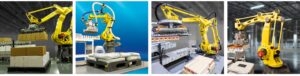
Robotic Palletising
Manual palletising is physically demanding and can contribute to workplace injuries over time.
Industrial robots automate the stacking of products onto pallets with exceptional speed and accuracy.
Robotic palletising systems help businesses:
- Increase packing efficiency
- Improve pallet consistency
- Reduce manual handling injuries
- Handle varying product sizes
- Operate continuously throughout multiple shifts
Palletising robots are commonly used in food manufacturing, logistics, beverage production, consumer goods and warehousing.
Pick and Place Operations
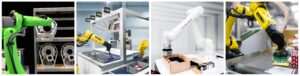
Pick and place automation has become one of the fastest-growing applications of industrial robots.
Using integrated vision systems, industrial robots identify, pick, orientate and position products with incredible precision.
Pick and place robots are commonly used for:
- Packaging
- Electronics assembly
- Food production
- Pharmaceutical manufacturing
- Medical devices
- Component sorting
Their speed and repeatability significantly improve production output while reducing handling errors.
Automated Painting
Industrial painting requires consistent application while maintaining strict environmental and workplace safety standards.
Robotic paint systems apply coatings with remarkable accuracy while reducing overspray and improving paint utilisation.
Automated painting applications include:
- Automotive manufacturing
- Agricultural equipment
- Heavy machinery
- Mining equipment
- Powder coating
- Protective coatings
Robotic paint systems also reduce operator exposure to hazardous environments while delivering a consistently high-quality finish.

Material Handling
Material handling robots automatically transport products, components and raw materials throughout manufacturing facilities.
Businesses use robotic systems to streamline production flow between workstations.
Material handling robots improve:
- Workflow efficiency
- Production speed
- Inventory movement
- Manufacturing flexibility
- Overall productivity
Quality Inspection
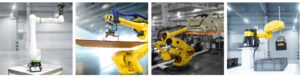
Vision-guided industrial robots have become valuable quality assurance tools.
Using advanced cameras, sensors and laser technology, robots inspect products for defects with remarkable consistency.
Inspection robots can detect:
- Surface imperfections
- Dimensional inaccuracies
- Missing components
- Assembly defects
- Product orientation issues
Automated inspection reduces waste, improves customer satisfaction and helps manufacturers maintain strict quality standards.
Industries Using Industrial Robots
The application of industrial robots extends across almost every manufacturing sector.
Industries benefiting from industrial robotics include:
- Automotive manufacturing
- Aerospace
- Food and beverage production
- Pharmaceutical manufacturing
- Plastics processing
- Metal fabrication
- Mining
- Foundries
- Packaging
- Warehousing and logistics
- Agriculture
- Medical device manufacturing
- Consumer goods
- Electronics manufacturing
As robotic technology becomes increasingly accessible, small and medium-sized manufacturers are also adopting automation to improve competitiveness.
Benefits of the Application of Industrial Robots
The growing application of industrial robots is driven by the significant advantages they provide across manufacturing operations.
Increased Productivity
Industrial robots operate continuously with consistent cycle times and minimal interruptions.
Unlike manual processes, robots do not become fatigued, allowing businesses to maximise production output while improving equipment utilisation.
Improved Product Quality
Repeatability is one of the greatest strengths of industrial robotics.
Every programmed movement is performed with exceptional precision, reducing variation between products and improving manufacturing quality.
Enhanced Workplace Safety
Many manufacturing environments expose employees to hazardous conditions.
Industrial robots safely perform tasks involving:
- Heavy lifting
- Extreme temperatures
- Hazardous chemicals
- Welding fumes
- Repetitive movements
- Dangerous machinery
Removing employees from high-risk tasks helps reduce workplace injuries while creating a safer manufacturing environment.
Reduced Operating Costs
Although industrial robots require an upfront investment, they often generate significant long-term savings through:
- Increased production output
- Reduced product waste
- Less rework
- Improved energy efficiency
- Reduced downtime
Many businesses experience an excellent return on investment through improved operational efficiency.
Greater Manufacturing Flexibility
Modern industrial robots can often be reprogrammed to suit new products or changing production requirements.
This flexibility allows manufacturers to respond quickly to customer demand while future-proofing their operations.
Industrial Robots and Industry 4.0
Industrial robots play a central role in the evolution of Industry 4.0 and smart manufacturing.
Today’s robotic systems may integrate with:
- Manufacturing Execution Systems (MES)
- Enterprise Resource Planning (ERP) software
- Machine vision systems
- Artificial intelligence
- Industrial Internet of Things (IIoT)
- Predictive maintenance platforms
- Real-time production monitoring
These connected technologies provide valuable manufacturing insights that help businesses improve productivity, optimise processes and reduce unplanned downtime.
As Industry 4.0 continues to develop, industrial robots will become even more intelligent, collaborative and adaptable.
Why Choose Automated Solutions Australia?
While understanding the application of industrial robots is important, achieving successful automation depends on selecting the right integration partner.
At Automated Solutions Australia (ASA), we specialise in designing and integrating advanced FANUC industrial robot solutions for manufacturers across Australia. Our experienced team works closely with businesses to develop automation systems that improve productivity, increase efficiency and deliver long-term value.
Our robotic automation solutions include:
- Machine tending
- Robotic welding
- Robotic palletising
- Pick and place automation
- Automated painting
- Material handling
- Vision-guided robotics
- Custom robotic cells
From initial consultation and system design through to installation, commissioning and ongoing support, we provide complete turnkey robotic automation solutions tailored to each customer’s manufacturing requirements.
Whether you’re introducing automation for the first time or expanding an existing production line, Automated Solutions Australia has the expertise to help you maximise the benefits of industrial robotics.
The Future of the Application of Industrial Robots
The application of industrial robots will continue to expand as automation technology becomes more intelligent, connected and accessible.
Manufacturers that invest in robotics today are positioning themselves for greater efficiency, improved quality and stronger long-term competitiveness. As customer expectations grow, robotic automation is becoming an essential part of successful manufacturing operations.
From machine tending and welding to palletising, painting, inspection and material handling, industrial robots are transforming how Australian businesses manufacture products.
For organisations looking to improve productivity, enhance workplace safety and remain competitive in an evolving market, industrial robotics offers a proven path to sustainable growth.
As one of Australia’s trusted FANUC robot integrators, Automated Solutions Australia is proud to help manufacturers unlock the full potential of robotic automation through innovative, reliable and tailored industrial robot solutions.