

Shot Blasting Robot: Transform Surface Preparation with Robotic Automation
Australian manufacturers face increasing pressure to improve productivity, maintain consistent quality and protect their workforce. At the same time, they need to control operating costs and meet demanding production schedules.
Surface preparation is an important part of this challenge. Whether you manufacture metal components, process castings, or prepare products for coating, you need a reliable and consistent finish.
However, traditional blasting methods can involve repetitive manual work, demanding operating conditions and variations in surface quality. As production requirements grow, these challenges can become even harder to manage.
That is where a Shot Blasting Robot can make a real difference.
At Automated Solutions Australia (ASA), we integrate FANUC industrial robots into practical automation systems that help Australian manufacturers improve their production processes. By combining robotic technology with specialist blasting equipment, we help businesses automate demanding tasks and achieve more consistent results.
Furthermore, robotic blasting can support higher production output, reduce direct worker exposure to blasting hazards and create opportunities for more automated manufacturing.
In this article, we explain how robotic shot blasting works, where manufacturers can use it and how ASA can help you explore the right solution for your business.
What is a Shot Blasting Robot?
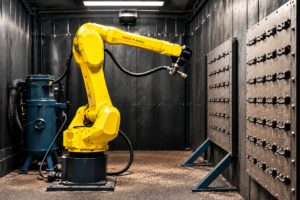
A shot blasting robot uses an industrial robot to automate the movement of blasting equipment or a component during surface treatment.
Instead of relying entirely on manual operation, manufacturers can program the robot to follow a defined path around the workpiece. As a result, the system can deliver more repeatable movements and consistent surface coverage.
Depending on the application, the robot may move a blasting nozzle around a stationary component or manipulate the component through a controlled blasting process.
A complete robotic blasting cell may include:
- A FANUC industrial robot selected for the application.
- Specialist shot blasting or abrasive delivery equipment.
- A purpose-designed blasting enclosure.
- Component fixtures and positioning equipment.
- Dust extraction and filtration systems.
- Robot controls and operator interfaces.
- Safety guarding, interlocks and monitoring systems.
Each component plays an important role. Therefore, successful automation requires careful integration of the robot, blasting equipment and supporting systems.
At ASA, we look at the entire manufacturing process rather than treating the robot as a standalone machine. This approach helps us develop solutions that suit your components, production volumes and factory environment.
How Does Robotic Shot Blasting Work?
Every successful robotic blasting project starts with understanding the required surface finish.
First, we consider the component’s material, shape, dimensions and production requirements. We also assess the existing blasting process and identify opportunities to improve consistency or reduce unnecessary handling.
Next, the system uses a programmed robotic path to control the movement and orientation of the blasting equipment or workpiece.
During the cycle, the blasting system directs abrasive media towards the target surface. The impact removes unwanted material or creates the required surface texture, depending on the process.
Once the cycle finishes, the component can move to inspection, coating or another manufacturing stage.
The biggest advantage is repeatability. Once engineers establish and validate the correct process, the robot can reproduce the programmed movements across successive components.
Consequently, manufacturers can reduce variations caused by repetitive manual movements and establish a more controlled production process.
Of course, the robot is only one part of the equation. Abrasive selection, blasting pressure, nozzle positioning and component geometry also influence the final result. That is why careful system design and process testing remain essential.
Five Benefits of a Shot Blasting Robot
1. Achieve More Consistent Surface Preparation
Surface preparation can directly affect the quality and performance of a finished product.
For example, manufacturers often need to remove scale, clean castings or prepare metal surfaces before applying protective coatings. If the blasting process varies, the final surface may also vary.
Manual blasting can introduce differences in nozzle angle, distance, travel speed and coverage. Over time, these inconsistencies may lead to additional processing or quality concerns.
A shot blasting robot follows a defined program, helping maintain consistent movements throughout each cycle.
As a result, manufacturers can improve repeatability and establish more reliable process standards.
2. Improve Workplace Safety
Abrasive blasting can expose workers to dust, noise, flying particles and other workplace hazards. In addition, manual blasting often requires repetitive movements and prolonged work in protective equipment.
Robotic automation helps reduce the need for workers to perform the blasting task directly.
Instead, operators can focus on loading components, checking quality, monitoring production and maintaining equipment, depending on the system design.
Meanwhile, a properly engineered blasting enclosure can help contain the process and support effective dust extraction.
Importantly, automation does not eliminate every risk. Manufacturers still need suitable guarding, interlocks, extraction systems, safe maintenance procedures and operator training.
Nevertheless, a well-designed robotic cell can play an important role in reducing direct exposure to demanding blasting conditions.
3. Increase Productivity and Throughput
Manual blasting can become a bottleneck when production volumes increase.
Workers must repeat the same movements across multiple components, while changes in fatigue, part geometry and operating conditions can affect cycle times.
A shot blasting robot can perform programmed movements repeatedly and may support longer operating periods when the complete system allows it.
Furthermore, automated loading and unloading can reduce interruptions between cycles.
For example, manufacturers can integrate robotic blasting with component positioning or material handling equipment. This helps streamline the movement of parts through the production process.
Consequently, businesses may increase throughput, improve equipment utilisation and plan production more effectively.
Actual results will depend on the component, blasting requirements and overall cell configuration. Therefore, we recommend assessing cycle times and handling requirements before selecting a solution.
4. Reduce Rework and Unnecessary Waste
Inconsistent blasting can create avoidable costs.
If a component does not meet the required surface finish, manufacturers may need to repeat the process. In some cases, poor preparation can also affect subsequent coating or finishing operations.
Robotic automation helps reduce process variation by repeating established movements and maintaining the intended operating parameters.
In addition, engineers can optimise the robot’s path to improve coverage and avoid unnecessary movement.
This can help manufacturers use abrasive media more efficiently and reduce avoidable rework.
Over time, these improvements may support better product quality and lower operating costs. However, the actual savings will depend on the existing process and the performance of the integrated system.
5. Support Lights-Out Manufacturing
Many Australian manufacturers want to increase production without adding unnecessary complexity to their operations.
Robotic blasting can contribute to this goal by automating repetitive work and connecting the process with other production equipment.
For instance, a suitably designed cell may process a batch of components with limited operator intervention. With additional integration, manufacturers may also automate loading, unloading and transfers to downstream operations.
As a result, businesses can explore longer production runs and move towards lights-out manufacturing.
However, unattended operation requires more than a robot. The system must also manage faults, component detection, consumables, safe shutdowns and maintenance requirements.
At ASA, we consider these practical requirements when developing automation concepts, helping manufacturers plan for reliable operation rather than simply automating one isolated task.
Shot Blasting vs Sandblasting: What’s the Difference?
Shot blasting and sandblasting both use abrasive media to treat surfaces. However, they generally use different methods to propel that media.
Shot blasting typically uses a mechanical wheel to propel abrasive material at high speed. Manufacturers commonly use this process for cleaning, descaling and treating suitable industrial components.
Sandblasting, often called abrasive blasting, generally uses compressed air to propel abrasive material through a nozzle. The media does not have to be sand.
Both processes have advantages. The right choice depends on the component material, surface requirements, production volume and desired finish.
For example, one application may suit a wheel-driven blasting system, while another may benefit from the flexibility of a robot-controlled abrasive blasting nozzle.
Therefore, manufacturers should assess the entire application before choosing a process.
ASA can help you explore the automation options available for your production environment. Learn more about our robotic sandblasting solutions and how robotic integration can support automated surface preparation.
Why Use FANUC Robots for Automated Blasting?
Choosing the right industrial robot is essential for achieving a successful result.
FANUC offers a broad range of industrial robots, allowing integrators to select equipment according to reach, payload and application requirements.
For robotic blasting, several factors deserve particular attention.
Reach and accessibility: The robot must reach the required surfaces without compromising the planned movement.
Payload: Engineers must account for the tooling, hoses and equipment carried by the robot.
Repeatability: The robot must reproduce its programmed movements to support a consistent process.
Environmental protection: The system design must account for abrasive media, dust, hose routing and exposure to the operating environment.
System integration: The robot must communicate effectively with the blasting equipment, safety systems and other production machinery.
At ASA, we select and integrate FANUC robots according to the demands of each application. We also consider the supporting equipment required to make the entire cell work effectively.
This means manufacturers receive an integrated automation solution designed around their production requirements.
Explore ASA’s industrial robotics solutions to see how FANUC technology can support your manufacturing operations.
How ASA Integrates Robotic Shot Blasting Systems
A successful shot blasting project involves much more than installing a robot.
At Automated Solutions Australia, we focus on the practical requirements of your manufacturing process from the beginning.
Step 1: Understand Your Application
First, we assess your components, production volumes, current blasting method and required surface finish.
We also identify any bottlenecks, handling challenges or quality issues that automation could address.
This gives us a clear understanding of what the system needs to achieve.
Step 2: Design the Right Solution
Next, we consider the robot, blasting equipment, fixtures, enclosure and handling requirements.
We also assess available floor space and how the new cell will connect with existing equipment.
By planning these elements together, we can develop a solution that fits your factory and production workflow.
Step 3: Plan and Optimise Robot Movements
Robot programming plays a crucial role in achieving consistent coverage.
Where appropriate, engineers can use offline simulation to assess reach, identify potential collisions and refine robot paths before commissioning.
This helps identify design issues early and supports a smoother installation process.
Step 4: Integrate Controls and Safety
The robot must work in coordination with the complete blasting cell.
Therefore, we consider the controls, operator interface, blasting equipment, guarding and safety devices as part of the overall design.
This ensures that the system supports safe operation, maintenance and fault recovery.
Step 5: Commission and Support the System
Finally, commissioning verifies that the equipment operates as intended and that the process meets the agreed requirements.
Training also helps operators and maintenance teams understand how to use the system effectively.
With the right design and support, robotic blasting can become a valuable part of a manufacturer’s long-term automation strategy.
Which Industries Can Benefit from Robotic Shot Blasting?
Robotic blasting can support many industries that rely on consistent surface preparation.
For example:
- Metal fabrication: Prepare steel components for coating or finishing.
- Foundries: Clean and treat suitable cast components.
- Automotive manufacturing: Automate selected metal component treatments.
- Heavy industry: Process suitable machinery parts and industrial components.
- General manufacturing: Reduce repetitive manual blasting tasks.
The best application depends on the material, component geometry and required result.
It is also important to distinguish shot blasting from shot peening. Shot peening is a specific process designed to induce compressive residual stresses in suitable components. It requires its own validated parameters and quality controls.
By understanding these differences, manufacturers can choose the right process for their products.
Why Choose Automated Solutions Australia?
At ASA, industrial robot integration is our speciality.
Since 2002, we have worked with FANUC robotics and helped Australian manufacturers explore practical ways to automate production.
Our experience spans several key applications, including machine tool tending, robotic paint finishing, welding and palletising. We also work across other industrial automation applications where robotic technology can improve manufacturing processes.
Most importantly, we focus on how the complete system will perform in your factory.
We consider your components, production requirements, operating environment and business objectives before developing an automation solution.
With operations in Adelaide and Brooklyn, Victoria, ASA supports manufacturers across Australia.
Whether you want to improve an existing blasting process or investigate a new robotic cell, we can help you understand the available options.
Frequently Asked Questions About Shot Blasting Robots
What is a shot blasting robot?
A shot blasting robot is an industrial robot integrated with blasting equipment to automate surface treatment. It follows programmed movements to help achieve repeatable coverage and more consistent processing.
What are the main benefits of robotic shot blasting?
Robotic shot blasting can improve process repeatability, increase productivity and reduce the need for workers to perform blasting directly. Depending on the application, it may also reduce rework and improve abrasive utilisation.
Can FANUC robots be used for shot blasting?
Yes. Suitable FANUC industrial robots can be integrated into robotic blasting systems. The correct configuration depends on reach, payload, tooling, process requirements and environmental conditions.
Is shot blasting the same as sandblasting?
No. Shot blasting typically uses a mechanical wheel to propel abrasive media, while sandblasting generally uses compressed air. Both prepare surfaces, but the best method depends on the application.
Can robotic blasting support lights-out production?
Yes, where the complete system supports unattended operation. Manufacturers must consider automated handling, fault detection, consumables, safety controls and reliable recovery procedures.
How much does a shot blasting robot cost?
Costs vary according to the robot, blasting equipment, enclosure, extraction, handling systems and integration requirements. An application assessment is the best starting point for developing a realistic budget.
How can ASA help with robotic blasting?
ASA integrates FANUC robots into industrial automation systems. We can help manufacturers assess their application, develop a suitable system concept and plan the integration requirements.
Ready to Explore Robotic Shot Blasting?
A shot blasting robot can help Australian manufacturers improve surface preparation, increase production efficiency and reduce repetitive manual work.
However, the best results come from choosing the right equipment and integrating every part of the process correctly.
At Automated Solutions Australia, we combine FANUC robotics with application-focused engineering to help manufacturers solve real production challenges.
Are you considering automated shot blasting or looking to improve your current blasting process?
Contact ASA to discuss your application, explore the available options and identify opportunities to improve your manufacturing operations.
Visit our Shot Blasting solutions page or call 1800 762 687 to start the conversation.
Let’s explore how robotic automation can help your business build a more consistent, productive and competitive manufacturing process.