

Sandblasting Robot: Automated Sandblasting with FANUC Robots
Sandblasting is an important part of surface preparation across many manufacturing and industrial applications. However, traditional manual blasting can be repetitive, physically demanding and difficult to keep consistent.
That is where a sandblasting robot can make a significant difference.
By combining industrial robotics with automated abrasive blasting equipment, manufacturers can achieve more consistent surface preparation, improve productivity and reduce the need for workers to operate directly in harsh blasting environments.
At Automated Solutions Australia (ASA), we design and integrate FANUC robotic sandblasting systems for Australian manufacturers. Our engineering team works from the initial concept and system design through to robot programming, installation, commissioning and ongoing support. ASA has been a FANUC robot integrator since 2002 and specialises in bespoke robotic automation solutions.
So, how does robotic sandblasting work, and could a sandblasting robot be the right solution for your manufacturing process?
What Is a Sandblasting Robot?
A sandblasting robot performs abrasive blasting automatically by following precise, pre-set movements.
Instead of an operator manually controlling the blasting nozzle, the robot follows a programmed path around the workpiece. This allows the blasting process to be repeated with a high level of consistency.
A typical robotic sandblasting system can include:
- An industrial FANUC robot
- A blasting nozzle or blasting tool
- Abrasive media delivery equipment
- A blasting enclosure or cell
- Part fixtures or positioning equipment
- Dust extraction and filtration
- Safety equipment and interlocks
- Robot and PLC controls
- Automated material handling
The exact configuration depends on the component, abrasive media, production volume and required surface finish.
As a result, robotic sandblasting is not simply a robot holding a blasting nozzle. It is a complete automated system designed around the manufacturing process.
How Does Robotic Sandblasting Work?
The principle behind robotic sandblasting is straightforward.
First, the workpiece is positioned inside the automated blasting cell. The FANUC robot then moves the blasting tool along a programmed path.
During the cycle, the system can control factors such as:
- Robot movement
- Tool position
- Blasting angle
- Travel speed
- Coverage
- Cycle time
- Abrasive delivery
Because the robot follows the same programmed movement each time, the process becomes highly repeatable.
This is particularly useful when manufacturers need to process the same component again and again.
Instead of relying on an operator to reproduce the same movements throughout every shift, the robot can repeat the programmed process consistently.
Consequently, manufacturers can achieve more predictable surface preparation while reducing process variation.
Why Automate Sandblasting?
Manual sandblasting can be an effective process. However, it can also create challenges when production volumes increase or when components require highly consistent treatment.
Automation can help address these challenges.
1. Improved Consistency
One of the biggest advantages of a sandblasting robot is repeatability.
A robot can follow the same programmed path for every component. Therefore, each part can receive a more consistent blasting process.
This can be particularly valuable when surface preparation needs to meet a specific quality standard before painting, coating or another manufacturing process.
2. Increased Productivity
Robotic automation can also improve production efficiency.
Once a robotic blasting cell has been correctly programmed and commissioned, it can perform repetitive blasting cycles without the same level of manual intervention.
As a result, manufacturers can potentially process more components while reducing bottlenecks in production.
ASA designs robotic automation solutions with a focus on improving throughput, quality and productivity.
3. Reduced Operator Exposure
Sandblasting environments can involve dust, noise, vibration and other workplace hazards.
A major advantage of automated blasting is that workers can be removed from the immediate blasting environment.
Instead, the robot performs the repetitive blasting operation inside a controlled cell.
This does not remove the need for proper engineering controls, guarding, ventilation or workplace safety procedures. However, it can significantly change how operators interact with the process.
4. Better Process Control
Manual blasting can vary depending on the operator, component and conditions.
Robotic blasting provides greater control over the robot’s movement and programmed path.
This means manufacturers can establish a repeatable process and make adjustments when required.
For example, the robot’s path can be programmed around complex component geometry rather than relying on an operator to manually reproduce the same movement.
5. Reduced Waste
Robotic blasting can also help manufacturers use abrasive media more efficiently.
ASA’s experience with robotic shot blasting and peening includes controlling the blasting process with a robot so that the nozzle can be accurately positioned. This can help avoid unnecessary cross-firing of media and reduce abrasive attrition.
Sandblasting Robot vs Manual Sandblasting
The biggest difference between manual and robotic sandblasting is control and repeatability.
With manual blasting, an operator controls the tool and movement. Therefore, results can vary from one cycle to the next.
With robotic sandblasting, the robot follows a programmed path.
That means the blasting process can be repeated much more consistently.
| Manual Sandblasting | Robotic Sandblasting |
|---|---|
| Operator controls the blasting path | Robot follows a programmed path |
| Greater operator variability | Highly repeatable movement |
| Repetitive manual work | Automated repetitive operation |
| Operator works around the blasting process | Robot can operate inside a controlled cell |
| Difficult to reproduce identical movements | Programmed movements can be repeated |
| Production can depend heavily on operator availability | Designed for consistent automated cycles |
Of course, automation is not automatically the right choice for every blasting application.
The best solution depends on production volume, component geometry, cycle time, surface requirements and the overall manufacturing process.
What Can a Sandblasting Robot Be Used For?
A robotic sandblasting system can be designed for many different industrial applications.
Depending on the system, robotic abrasive blasting can be used for:
- Surface preparation
- Cleaning components
- Removing contaminants
- Preparing surfaces for painting
- Preparing surfaces for protective coatings
- Treating heavy industrial components
- Automotive manufacturing
- Aerospace manufacturing
- Construction and structural components
The process can also be adapted for different component sizes and production requirements.
For example, a smaller robotic cell may be suitable for repetitive blasting of individual components. On the other hand, larger industrial robots can handle larger workpieces and applications that require greater reach and payload.
What Is the Difference Between Sandblasting, Grit Blasting and Shot Blasting?
You may also hear terms such as abrasive blasting, grit blasting and shot blasting when researching robotic blasting systems.
These terms are related, but they are not always interchangeable.
Abrasive blasting is the broader process of using abrasive media to clean, prepare or modify a surface.
Sandblasting is a commonly used term for abrasive blasting, even though modern systems may use a range of abrasive media rather than traditional sand.
Grit blasting generally refers to blasting using abrasive particles such as grit.
Shot blasting typically uses metallic or other specific media and is widely used for cleaning, finishing and surface treatment.
The correct process depends on the material, surface condition and desired result.
Therefore, choosing the right robotic system starts with understanding the actual manufacturing requirement rather than simply selecting a robot.
Why Use a FANUC Robot for Sandblasting?
The robot is only one part of an automated blasting system. However, selecting the right robot is still critical.
FANUC offers a broad range of industrial robots with different payloads, reaches and configurations.
This allows the robotic system to be matched to the application.
For example, smaller robots can be suitable for compact components and detailed applications. Meanwhile, larger FANUC robots can provide the reach and payload required for bigger industrial workpieces.
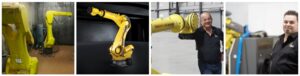
ASA’s existing robotic blasting applications include FANUC M-10, M-20, M-710 and R-2000 series robots.
Designing a Robotic Sandblasting Cell
A successful robotic sandblasting project involves much more than choosing a robot.
The entire process needs to work together.
Robot Selection
The robot needs to have the appropriate reach, payload and movement for the application.
Tooling
The blasting nozzle and tooling need to work effectively with the robot and abrasive delivery system.
Part Positioning
Components may need to be fixed or positioned so the robot can access the required surfaces.
Enclosure
The blasting process needs to operate within an appropriately engineered environment.
Dust Extraction
Dust management and extraction are important considerations when designing a blasting cell.
Safety Systems
Guarding, interlocks, emergency stops and other safety measures need to be incorporated into the system design.
Robot Programming
The robot needs to be programmed to achieve the required blasting path, coverage and cycle time.
Material Handling
For higher-volume applications, automated loading and unloading can also be incorporated.
Therefore, the best robotic sandblasting systems are designed as complete automation solutions.
Can Robotic Sandblasting Be Customised?
Yes.
In fact, customisation is often essential.
Every manufacturing process is different. Components have different sizes, shapes, materials and surface requirements. Production volumes also vary significantly between businesses.
For this reason, a robotic sandblasting system should be designed around the application.
At ASA, the engineering process can include concept development, cell design, robot path simulation, programming, construction, installation, commissioning and training. The company also provides ongoing support for its FANUC automation systems.
This approach allows the automation to be developed around the manufacturer’s actual requirements.
The Benefits of Robotic Sandblasting for Australian Manufacturers
Australian manufacturers are under constant pressure to improve productivity while maintaining quality and controlling costs.
At the same time, many businesses are looking for ways to reduce repetitive manual tasks and improve workplace safety.
Robotic sandblasting can address several of these challenges at once.
A well-designed system can provide:
Greater consistency
The robot follows programmed movements to deliver repeatable blasting cycles.
Improved productivity
Automation can reduce repetitive manual work and help increase production capacity.
Better process control
Key movements and blasting paths can be programmed and refined.
Improved workplace safety
Operators can be removed from direct exposure to the blasting process.
Reduced variation
Automated movement reduces the variability associated with manually repeating the same process.
Greater production flexibility
Robot programs can be adjusted for different components and production requirements.
For manufacturers considering automation, the important question is not simply whether a robot can perform the task.
The better question is whether automation can improve the entire process.
Why Choose Automated Solutions Australia for Robotic Sandblasting?
Choosing a sandblasting robot is only the beginning.
The real value comes from designing an automation system that works reliably within your manufacturing environment.
That is where Automated Solutions Australia can help.
ASA is an experienced FANUC robot integrator in Australia, with expertise across industrial automation applications including sandblasting, shot blasting and peening, material handling, painting, welding, machine tending and palletising.
Most importantly, ASA does not take a one-size-fits-all approach.
The system is designed around the customer’s process.
With operations in Adelaide and Melbourne and support available Australia wide, ASA works with manufacturers to develop practical robotic automation solutions for real production environments.
Frequently Asked Questions About Sandblasting Robots
What is a sandblasting robot?
A sandblasting robot is an industrial robot programmed to perform abrasive blasting automatically. It controls the movement of the blasting tool to provide consistent and repeatable surface treatment.
What are the benefits of robotic sandblasting?
The main benefits include improved consistency, repeatability, productivity and process control. Robotic systems can also reduce the need for operators to perform repetitive blasting work directly in the blasting environment.
Can FANUC robots be used for sandblasting?
Yes. FANUC industrial robots can be integrated into automated sandblasting and abrasive blasting systems. ASA has experience integrating FANUC robots for blasting applications across different component sizes and production requirements.
Is robotic sandblasting safer than manual sandblasting?
Robotic sandblasting can help remove operators from direct exposure to the blasting process. However, the complete system still needs to be properly engineered with appropriate guarding, extraction and safety controls.
What industries use robotic sandblasting?
Robotic blasting can be used across industries including automotive, aerospace, construction, heavy manufacturing and general industrial production.
Can a robotic sandblasting system be customised?
Yes. Robotic blasting cells can be designed around the size and shape of components, production volumes, required surface finish, cycle times, tooling and material handling requirements.
How much does a sandblasting robot cost?
There is no single price for a robotic sandblasting system. The total investment depends on the robot, blasting equipment, enclosure, extraction, tooling, safety systems, material handling and level of automation required.
The best way to determine the cost is to assess the application and design a system around the actual production requirements.
Take the Next Step Towards Robotic Sandblasting
If your business is spending significant time on manual sandblasting, now could be the right time to investigate automation.
A sandblasting robot can bring greater consistency, improved productivity and better process control to repetitive surface preparation tasks.
More importantly, the right system can be designed around your production process.
At Automated Solutions Australia, our team can assess your application and explore how a FANUC robotic sandblasting system could work within your manufacturing environment.
With more than 20 years of FANUC integration experience, ASA can support your project from the initial concept through to installation, programming, commissioning and ongoing support.
Ready to explore robotic sandblasting for your business?
Contact Automated Solutions Australia on 1800 ROBOTS (1800 762 687) and speak with our automation team about your application.