


Industry Robotics: Transforming Australian Manufacturing With Intelligent Automation
Manufacturing has always been about finding better ways to produce quality products faster, safer and more efficiently. Today, industry robotics is driving that evolution. Across Australia, manufacturers are investing in advanced robotic automation to improve productivity, reduce operational costs and stay competitive in an increasingly demanding market.
From family-owned fabrication workshops to large-scale production facilities, businesses are discovering that industrial robotics delivers more than faster production. It creates safer workplaces, improves product consistency and provides the flexibility needed to respond to changing customer demands. As a result, manufacturers can increase output while maintaining exceptional quality standards.
At Automated Solutions Australia, we help businesses unlock these benefits through intelligent robotic integration. We design, build and support bespoke automation solutions that solve real manufacturing challenges. Whether you’re looking to automate a single production process or transform an entire facility, our team delivers practical robotics solutions that generate measurable results.
Most importantly, we understand Australian manufacturing. Every production environment is different, so every automation solution therefore is too.
What is Industry Robotics?
Industry robotics refers to the use of programmable robotic systems to automate manufacturing and industrial processes. These robots perform repetitive, hazardous or highly accurate tasks with remarkable speed and consistency, allowing businesses to improve efficiency without compromising quality.
Unlike traditional automation equipment that performs one dedicated function, modern industrial robots are incredibly versatile. They can load CNC machines, weld components, apply paint finishes, palletise products, inspect parts, package goods and complete hundreds of other manufacturing tasks. Furthermore, they can be reprogrammed as production requirements evolve, making them a long-term investment rather than a fixed-purpose machine.
As manufacturing embraces Industry 4.0, robotics has become a central part of connected production environments. Today’s robotic systems communicate with CNC machines, PLCs, vision systems and production software, creating smarter factories capable of collecting real-time data and continuously improving performance.
Consequently, manufacturers gain greater visibility over production while reducing waste, increasing uptime and making better business decisions.
Why Industry Robotics is Becoming Essential in Australian Manufacturing
Australian manufacturers face unique challenges. Operating costs are increasing and customers expect shorter lead times without sacrificing quality. At the same time, global competition continues to grow.
Fortunately, industry robotics provides practical solutions to each of these challenges.
Instead of relying solely on manual processes, manufacturers can automate repetitive production tasks while allowing skilled employees to focus on programming, quality assurance, maintenance and continuous improvement. Therefore, businesses improve productivity without simply increasing workforce numbers.
Industrial robotics also provides something every manufacturer values, consistency.
Unlike manual production, robotic systems repeat the same movement thousands of times with exceptional accuracy. Consequently, product quality remains consistent from the first component to the last.
Businesses implementing robotic automation frequently achieve:
- Higher production output
- Greater manufacturing consistency
- Improved product quality
- Lower operating costs
- Reduced production waste
- Increased equipment utilisation
- Better workplace safety
- Faster production cycles
- Improved delivery performance
- Greater manufacturing flexibility
Because robotic systems operate continuously with minimal downtime, they help manufacturers maximise every production hour. In many cases, this leads to significant improvements in overall equipment effectiveness (OEE), allowing businesses to get more from their existing machinery.
The Key Benefits of Industrial Robotics
Increased Productivity
One of the biggest advantages of industry robotics is productivity.
Industrial robots maintain consistent cycle times throughout every shift. They don’t become fatigued, and they don’t vary their performance over long production runs. Consequently, manufacturers can increase throughput while maintaining predictable production schedules.
Furthermore, robots can often operate outside normal working hours. This enables businesses to increase production capacity without expanding their factory footprint. This allows for 24/7 operations.
Improved Product Quality
Quality remains one of the strongest reasons manufacturers invest in industrial robotics.
Because robots repeat programmed movements with exceptional precision, every weld, paint finish, pallet stack or machine loading sequence remains consistent. As a result, manufacturers reduce variation between products while improving customer satisfaction.
This consistency also reduces costly rework, product defects and material waste.
Enhanced Workplace Safety
Many manufacturing tasks expose employees to hazardous conditions, including heavy lifting, welding fumes, paint fumes, repetitive movements, high temperatures and dangerous machinery.
Industrial robotics removes operators from these environments by automating repetitive or hazardous processes. Therefore, businesses create safer workplaces while reducing the risk of workplace injuries.
Rather than replacing skilled workers, robotics allows employees to perform higher-value work that requires critical thinking, problem-solving and technical expertise.
Lower Operating Costs
Although robotic systems require an initial investment, they often deliver substantial long-term savings.
For example, automation helps reduce:
- Product waste
- Downtime
- Rework
- Scrap rates
- Production delays
- Workplace injuries
- Energy consumption through process optimisation
Consequently, manufacturers improve profitability while strengthening their competitive position.
Greater Manufacturing Flexibility
Modern manufacturing changes quickly. Customer requirements evolve, production volumes fluctuate and product lines expand.
Fortunately, today’s industrial robots are designed with flexibility in mind.
Many robotic systems can switch between products with minimal programming changes. As a result, manufacturers respond more quickly to customer demands while maintaining efficient production.
Key Applications of Industry Robotics
Although robotics supports hundreds of industrial processes, several applications consistently provide strong return on investment. These automation solutions improve productivity, increase product quality and create safer manufacturing environments.
At Automated Solutions Australia, these are the applications we specialise in.
Machine Tool Tending Robots
Machine tool tending has become one of the fastest-growing applications within industrial robotics, particularly for Australian manufacturers operating CNC machining centres.
Traditionally, operators manually load raw materials into machines, wait for the machining cycle to finish and then unload completed components. While this process appears straightforward, it often results in valuable machining centres sitting idle while operators move between machines.
Machine tool tending robots eliminate this inefficiency.
Instead, robotic systems automatically load raw material, remove completed components and prepare the next machining cycle without unnecessary delays. Consequently, CNC machines spend more time cutting and less time waiting.
Machine tool tending robots can:
- Load CNC machines automatically
- Unload finished components
- Transfer parts between machining centres
- Rotate workpieces for secondary operations
- Perform basic quality inspections
- Manage multiple CNC machines simultaneously
- Operate continuously across extended production runs
Furthermore, robotic machine tending improves spindle utilisation, one of the most important performance indicators in modern machining operations.
Rather than investing in additional CNC equipment, many manufacturers increase production simply by improving machine utilisation through robotic automation.
For businesses experiencing growing production demands, machine tool tending provides one of the quickest and most effective automation opportunities available.

Robotic Welding Systems
Consistent welding requires skill, precision and repeatability. However, even experienced welders experience natural variation throughout long production runs.
Industrial welding robots solve this challenge by producing accurate, repeatable welds every time.
Using advanced programming and precise motion control, robotic welding systems maintain consistent travel speed, torch angle and weld penetration across every component. As a result, manufacturers achieve higher-quality welds while reducing defects and rework.
Robotic welding offers numerous advantages, including:
- Consistent weld quality
- Faster production
- Reduced distortion
- Improved operator safety
- Lower consumable usage
- Greater repeatability
- Reduced rework
- Improved production efficiency
Furthermore, robotic welding systems can operate in demanding production environments where consistency is critical.
Whether manufacturing structural steel, fabricated components, transport equipment or precision assemblies, robotic welding helps businesses deliver reliable quality while increasing production capacity.
Most importantly, automation allows experienced welders to focus on programming, inspection and complex fabrication rather than repetitive production welding.

Paint Robots: Achieving Superior Surface Finishes
A high-quality paint finish is about far more than appearance. It also protects products from corrosion, extends service life and reinforces your brand’s reputation. However, achieving a consistent finish by hand can be challenging, particularly across large production runs.
This is where paint robots deliver exceptional value.
Robotic painting systems apply coatings with outstanding accuracy, maintaining the correct spray distance, gun angle and application speed throughout every cycle. As a result, every component receives a consistent finish while reducing overspray and material waste.
Unlike manual spraying, robotic paint systems never become fatigued. Therefore, manufacturers achieve the same premium finish on the first product of the day as they do on the last.
Paint robots provide a range of benefits, including:
- Consistent coating thickness
- Improved surface finish quality
- Reduced paint consumption
- Lower overspray
- Increased transfer efficiency
- Faster production cycles
- Enhanced workplace safety
- Reduced exposure to hazardous environments
Furthermore, robotic paint systems integrate seamlessly into automated production lines, allowing manufacturers to increase throughput without compromising finish quality.
Whether you’re coating metal components, fabricated products or specialised industrial equipment, robotic painting delivers repeatable, high-quality results that are difficult to achieve through manual processes alone.

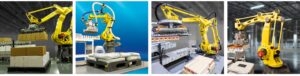
Robotic Palletising Systems
End-of-line operations often create production bottlenecks. While products may move efficiently through manufacturing, manual palletising can slow the entire process.
Fortunately, robotic palletising systems solve this problem.
Instead of relying on manual lifting and repetitive stacking, palletising robots automatically organise products onto pallets using programmed stacking patterns. Consequently, businesses improve dispatch efficiency while reducing the physical demands placed on employees.
Modern palletising robots can handle:
- Cartons
- Bags
- Drums
- Containers
- Trays
- Cases
- Bundled products
- Packaged goods
Furthermore, they can quickly adapt to changing product sizes and pallet configurations. As production requirements change, programming can be updated without replacing the robot.
The benefits of robotic palletising include:
- Faster end-of-line operations
- Reduced manual handling
- Improved workplace safety
- Consistent pallet quality
- Increased production capacity
- Lower labour costs
- Better warehouse efficiency
As a result, manufacturers improve productivity from production through to dispatch while minimising the risk of workplace injuries.
Industries Benefiting from Industry Robotics
Industry robotics has become a critical part of modern manufacturing across Australia. While automotive manufacturing helped drive early adoption, robotics now supports businesses in almost every industrial sector.
For example, manufacturers in the following industries regularly implement robotic automation:
- Automotive
- Food and beverage
- Mining
- Defence
- Steel fabrication
- Sheet metal manufacturing
- Plastics processing
- Packaging
- Warehousing and logistics
- Timber processing
- Agriculture
- Medical
- Aerospace
- Consumer products
Although every industry has unique production requirements, the objectives remain the same: improve efficiency, increase consistency and reduce operational costs.
Consequently, industrial robotics continues to play an increasingly important role in Australia’s manufacturing future.
Why FANUC Robotics Continues to Lead the Industry
Selecting the right robotic company is just as important as choosing the right automation partner.
At Automated Solutions Australia, we integrate FANUC robots because they consistently deliver the reliability, flexibility and performance Australian manufacturers demand.
FANUC has earned a global reputation for producing industrial robots capable of operating in demanding production environments for decades. Furthermore, its extensive product range allows manufacturers to automate applications ranging from delicate assembly work through to heavy-duty palletising.
FANUC robots are recognised for:
- Outstanding reliability
- Exceptional repeatability
- High-speed operation
- Advanced motion control
- Flexible programming
- Extensive payload options
- Long service life
- Strong global support network
- Low maintenance requirements
Because every manufacturing application is different, FANUC offers robots specifically designed for welding, painting, machine tending, palletising, material handling and many other industrial processes.
As a result, businesses gain a future-ready automation platform capable of adapting as production grows.
Choosing the Right Robotics Integrator
Even the most advanced robot will only perform as well as the system surrounding it.
Successful automation depends on careful planning, intelligent system design and expert integration. Therefore, selecting an experienced robotics integrator is one of the most important decisions you’ll make.
A trusted automation partner should provide far more than robot installation.
Instead, they should support your project from concept through to ongoing optimisation.
ASA offers:
- Automation consulting
- Process analysis
- Custom system design
- Robotic simulation
- Electrical engineering
- PLC integration
- Robot programming
- Vision system integration
- Safety system design
- Installation and commissioning
- Operator training
- Preventative maintenance
- Ongoing technical support
At ASA, we understand Australian manufacturing standards and design systems that integrate seamlessly into your existing production environment.
The goal isn’t simply installing a robot. It’s delivering a complete automation solution that continues creating value for years to come.
Why Choose Automated Solutions Australia?
At Automated Solutions Australia, we believe automation should solve real manufacturing challenges—not create new ones.
That’s why we work closely with every client to understand their production goals before designing a tailored robotic solution. Rather than offering one-size-fits-all systems, we engineer automation that fits your processes, your products and your future growth plans.
Our experienced team supports projects from the initial concept through to installation, commissioning and long-term support. Consequently, our clients gain a trusted automation partner rather than simply purchasing equipment.
We specialise in:
- Machine tool tending
- Robotic welding
- Paint robots
- Robotic palletising
- Material handling
- Industrial robot integration
- Custom automation solutions
- Production line optimisation
Every project focuses on delivering measurable outcomes, including:
- Increased productivity
- Improved product quality
- Reduced downtime
- Enhanced workplace safety
- Greater manufacturing flexibility
- Lower operating costs
- Faster return on investment
Most importantly, we remain committed to supporting Australian manufacturers long after the system is commissioned.
The Future of Industry Robotics
The future of industry robotics is exciting.
As artificial intelligence, machine vision and connected manufacturing continue to evolve, robotic systems are becoming even more capable, flexible and intelligent.
Increasingly, manufacturers are investing in technologies such as:
- Machine vision inspection
- Collaborative robots (cobots)
- Predictive maintenance
- Real-time production monitoring
- Smart manufacturing analytics
Together, these technologies create highly connected production environments where machines communicate, analyse performance and optimise manufacturing processes with minimal human intervention.
Consequently, businesses gain greater productivity while making faster, data-driven decisions.
As Industry 4.0 continues to mature, manufacturers embracing robotics today will be well positioned to remain competitive well into the future.
Frequently Asked Questions
What is industry robotics?
Industry robotics is the use of programmable robotic systems to automate manufacturing processes such as machine tool tending, welding, painting, palletising, material handling and assembly. These systems improve productivity, consistency and workplace safety while reducing operating costs.
What are the benefits of industrial robotics?
Industrial robotics increases production, improves product quality, reduces waste, lowers operating costs and enhances workplace safety. In addition, robotic systems provide exceptional consistency across long production runs while helping manufacturers respond to changing market demands.
What industries use industrial robots?
Industrial robots are widely used across automotive, food manufacturing, mining, defence, logistics, plastics, pharmaceuticals, steel fabrication, timber processing, agriculture and many other manufacturing industries.
What is machine tool tending?
Machine tool tending uses robotic systems to automatically load and unload CNC machines. As a result, manufacturers increase spindle utilisation, reduce idle time and improve production efficiency.
Why are paint robots better than manual painting?
Paint robots apply coatings with greater consistency, reduce overspray, improve transfer efficiency and create safer working environments. Consequently, manufacturers achieve superior finish quality while reducing material waste.
Is robotic automation suitable for small and medium-sized manufacturers?
Absolutely. Modern robotic systems are scalable and highly flexible, making automation a practical investment for businesses of all sizes. Many manufacturers begin by automating one repetitive process before expanding into additional applications as production grows.
Industry Robotics – Shaping the Future of Australian Manufacturing
Industry robotics is no longer reserved for large multinational manufacturers. Instead, businesses of every size are discovering how robotic automation improves efficiency, strengthens quality and creates safer workplaces.
Whether you’re looking to increase CNC utilisation through machine tool tending, improve consistency with robotic welding, achieve premium finishes using paint robots or streamline dispatch with robotic palletising, the right automation solution can transform your manufacturing operation.
At Automated Solutions Australia, we combine engineering expertise with industry-leading robotic technology to deliver automation solutions that create measurable business outcomes. From initial consultation through to integration and ongoing support, we help Australian manufacturers embrace smarter production with confidence.
As manufacturing continues to evolve, investing in industry robotics is no longer simply about staying current. Instead, it’s about building a more productive, more resilient and more competitive business for the future.
