


FANUC Robotic System Integration for Australian Manufacturing
Robotic system integration involves much more than installing a robot.
A successful robotic automation system needs every component to work together. The robot, tooling, controls, safety equipment, production machinery and software all need to communicate and operate as one system.
At Automated Solutions Australia (ASA), we design, engineer and integrate robotic systems for Australian manufacturers. As an experienced FANUC robot integrator, we use FANUC industrial robots and collaborative robots to develop automation solutions around your production process.
From the initial concept through to installation, programming and commissioning, our team manages the complete integration process. We can also provide ongoing support to help you get long-term value from your automation investment.
Whether you want to automate welding, paint finishing, machine tending, palletising, material handling, inspection or another repetitive process, we can help you identify the right robotic solution.
What is Robotic System Integration?
A robot is only one part of an automated manufacturing system.
Robotic system integration brings the robot together with the equipment and technology needed to complete a production task.
Depending on the application, your robotic system may include:
- FANUC industrial robots or collaborative robots
- End-of-arm tooling and grippers
- Welding equipment
- Paint and finishing equipment
- CNC machines and machine tools
- Conveyors and part handling systems
- Vision and inspection systems
- PLCs and machine controls
- Sensors and safety systems
- Fixtures and positioning equipment
- Robot programming
- Automated material handling
- Operator interfaces
The goal is simple. We want every part of the system to work together smoothly.
To achieve that, our team looks at the complete application. We consider your parts, production requirements, cycle times, available floor space, tooling, machinery, operator interaction and production workflow.
As a result, we can design a robotic automation system around the job it needs to perform, rather than simply supplying a robot and leaving the integration to someone else.

FANUC Robotic System Integration
FANUC sits at the heart of ASA’s robotic system integration capability.
ASA has been a FANUC robot integrator since 2002. Our engineering team works with FANUC robots from the initial concept and system design through to installation, programming, commissioning and ongoing support.
FANUC offers a broad range of industrial and collaborative robots. This range allows us to select a robot that matches the requirements of your application.
For example, different production tasks require different combinations of reach, payload, speed, accuracy and operating environment.
A welding application has different requirements to machine tending. Likewise, a heavy material handling application needs a different solution to a high-speed pick-and-place process.
That’s why we don’t simply choose a robot first.
We start with your process, then select the FANUC technology that best fits the application.
FANUC robotic systems can support applications including:
- Robotic welding
- Automated paint finishing
- Machine tool tending
- Robotic palletising
- Material handling
- Robotic vision inspection
- Deburring and polishing
- Material removal
- Picking and packaging
- Sealing and dispensing
- Shot blasting and peening
- Fibreglass and gelcoat applications
This combination of FANUC robotics and ASA engineering expertise allows us to develop complete robotic automation solutions for a wide range of manufacturing processes.
Complete Robotic Integration Services
A robot needs to communicate with the rest of your production environment.
For that reason, ASA approaches each project as a complete engineering solution.
Robotic System Design
First, we look at the application.
Our team assesses your production requirements, current process, equipment, parts, cycle times and available space. We then develop a robotic system concept around those requirements.
The design may include:
- Robot selection
- Cell layout
- Tooling
- Machine interfaces
- Controls
- Safety systems
This approach helps us create a system that fits your manufacturing environment.
FANUC Robot Selection
Different applications require different robots.
A high-speed handling application might need a lightweight, fast robot. In contrast, heavy material handling may require a high-payload FANUC robot with a longer reach.
Robotic welding, paint finishing and machine tending also have their own requirements.
Our team can assess the application and recommend a FANUC robot that suits the required payload, reach, speed, accuracy and operating environment.
End-of-Arm Tooling
The robot is only as effective as the tooling attached to it.
For example, a welding application requires different tooling from a palletising or machine tending system.
We therefore consider tooling as part of the complete robotic system. Our team can integrate grippers, welding equipment, paint equipment, cutting tools and other end-of-arm technology around the application.
This helps the robot perform the task reliably and consistently.
Robot Programming
Robot programming plays a major role in successful integration.
Our engineers program FANUC robots to perform the required movements and coordinate their operation with other equipment within the cell.
Depending on the application, programming may control:
- Robot movements
- Production sequences
- Tooling
- Sensors
- Machine communication
- Part handling
- Safety functions
We test and refine the system so the robot performs the required process consistently.
Controls Integration
The robot rarely works alone.
Instead, it often needs to communicate with CNC machines, PLCs, conveyors, sensors, vision systems and other production equipment.
Our team integrates these components so the different parts of the automation system can work together.
This creates a connected production cell rather than a standalone robot.
Safety Integration
Safety needs to form part of the system from the beginning.
Our team considers how operators, robots, machinery and other equipment will interact within the production environment.
We can integrate the required safety equipment and controls into the robotic cell as part of the overall system design.
This helps create an automation solution that supports both production requirements and safe operation.
Installation and Commissioning
Once we complete the design and build the system, our team installs and commissions the robotic cell.
We test the robot, tooling, controls and other equipment together. We then make any necessary adjustments before the system moves into production.
Our team can also provide operator training to help your staff use the new system confidently.
Robotic Automation Applications
Robotic automation can solve many repetitive manufacturing challenges.
However, the right solution depends on the process.
ASA integrates FANUC robots across a broad range of industrial applications.
Robotic Welding
Welding requires consistency.
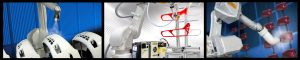
A FANUC robotic welding system can follow programmed paths repeatedly, helping manufacturers achieve consistent weld movements across production runs.
ASA can integrate FANUC welding robots with the required welding equipment, tooling, fixtures and controls.
The result is a complete robotic welding system designed around your production requirements.

Robotic Paint Finishing
Paint finishing can involve repetitive movements and demanding consistency.
FANUC paint robots can automate these movements while working alongside equipment such as conveyors, loaders, rotators and inspection systems.
ASA can design and integrate robotic paint finishing systems around your parts, coating process and production requirements.
This approach can help create a more controlled and repeatable finishing process.
Machine Tool Tending
Machine tool tending is another strong application for FANUC robotic automation.
A robot can load and unload parts from CNC machines. It can also transfer components between processes and perform repetitive handling tasks.
However, the robot needs to communicate with the machine and the wider production cell.
ASA integrates the FANUC robot, machine tool, tooling and controls into one coordinated system.

Robotic Palletising
Palletising involves repetitive lifting, positioning and stacking.
A FANUC palletising robot can automate these tasks while maintaining consistent product placement.
ASA can integrate robotic palletising systems around your products, pallet configurations, production rates and available floor space.
This can help reduce repetitive manual handling while creating a more consistent palletising process.
Material Handling
Manufacturers often need to move components between different stages of production.
Robotic material handling can automate these repetitive movements.
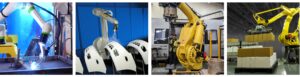
FANUC offers robots across a broad range of payloads. As a result, manufacturers can select technology suited to both lightweight and heavy-duty handling applications.
For example, the FANUC M-2000iA/2300 provides a payload capacity of up to 2.3 tonnes for extremely heavy applications.
ASA can integrate the appropriate FANUC robot with tooling, conveyors, fixtures and other production equipment to create a complete material handling system.
Robotic Vision Inspection
Robotics and machine vision can work together to automate inspection and quality control.
ASA integrates FANUC robotic vision inspection systems using FANUC’s integrated iRVision technology.
These systems can support applications such as:
- Presence and absence detection
- Defect detection
- Part identification
- OCR and OCV
- Colour verification
- Robotic sorting
By combining vision and robotics, manufacturers can bring inspection and handling together within the same automated process.
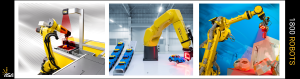
Deburring, Polishing and Material Removal
Deburring and finishing can involve repetitive movements.
Robots can perform these tasks with programmed and repeatable movements across a production run.
ASA can integrate FANUC robots with suitable tooling for applications such as deburring, polishing, cutting and other material removal processes.
Robotic Sandblasting and Surface Preparation
Surface preparation can also benefit from robotic automation.
A FANUC robot can perform programmed movements across a component while working with the appropriate blasting or surface preparation equipment.
ASA can integrate the robot, tooling, controls and process equipment into a complete automated cell.
This approach can improve repeatability while removing operators from repetitive surface preparation tasks.
Our Robotic System Integration Process
A successful automation project starts well before the robot arrives on your factory floor.
At ASA, we follow a structured process to develop and integrate robotic automation systems.
1. Understand Your Application
First, we learn how your current process works.
We look at the parts, production volumes, cycle times, machinery, operators, available space and current challenges.
This gives us a clear understanding of what the automation system needs to achieve.
2. Develop the Concept
Next, we develop a robotic automation concept around your requirements.
We consider the FANUC robot, tooling, equipment, cell layout, controls and safety requirements.
At this stage, we can also identify potential challenges before moving into detailed design.
3. Design the Robotic System
Once we establish the concept, our engineering team develops the system in greater detail.
We consider robot paths, tooling, equipment interfaces, safety systems, material flow and operator access.
The result is a detailed robotic system designed around your production process.
4. Simulate the Application
Where appropriate, simulation allows us to assess the proposed system before physical installation.
ASA has experience with FANUC simulation tools that can help us assess robot movements and visualise the proposed robotic cell.
This can help identify potential issues early and refine the system before it reaches the factory floor.
5. Build and Integrate
Next, we bring the components together.
Our team integrates the FANUC robot, tooling, controls, safety systems and other equipment into one complete robotic cell.
6. Program and Commission
We then program and test the robotic system.
Our engineers check the robot movements, tooling, machine communication and production sequence.
We make adjustments where necessary and commission the system for production.
7. Install and Train
Once the system is ready, our team installs it at your manufacturing facility.
We can also train operators and relevant production staff so they understand how to operate the robotic system.
8. Support and Optimise
Finally, we continue to support your automation system after installation.
ASA provides programming, production support, servicing and maintenance for FANUC robotic systems.
As your production requirements change, we can also help optimise or modify the system.
Why Choose ASA for Robotic System Integration?
Choosing a robotic system integrator is an important decision.
You need more than a company that can supply a robot.
You need a team that understands how robotics, machinery, controls and production processes work together.
FANUC Expertise
ASA has specialised in FANUC robot integration since 2002.
Our team understands FANUC technology and how to integrate it into complete industrial automation systems.
Complete Integration Capability
We can support your project from the initial concept through to system design, programming, installation and commissioning.
This gives you one experienced team across the key stages of the project.
Broad Application Experience
Our experience covers robotic welding, paint finishing, machine tending, palletising, material handling, vision inspection and other industrial applications.
As a result, we can approach your project from an application perspective rather than simply recommending a robot.
Solutions Built Around Your Process
Every manufacturing operation is different.
That’s why we design robotic systems around your production requirements.
We consider your parts, equipment, floor space, production targets and existing processes before developing the solution.
Ongoing Support
Our relationship doesn’t end when we commission your robotic cell.
We can provide ongoing programming, servicing, maintenance and production support to help you get long-term value from your FANUC automation system.
Robotic System Integration Across Australia
ASA provides robotic system integration services to manufacturers across Australia.
Our Adelaide and Melbourne operations support customers across Australia, while our team also has experience delivering automation projects internationally.
Whether you want to automate one repetitive task or develop a complete robotic production cell, we can help.
Our FANUC expertise, engineering capability and application experience allow us to develop robotic automation solutions for a wide range of manufacturing environments.

Frequently Asked Questions
What does a robotic system integrator do?
A robotic system integrator designs and connects the components required to create a complete automated system.
This can include the robot, tooling, machinery, controls, safety equipment, sensors, vision technology and software.
ASA integrates FANUC robots into complete robotic automation systems for Australian manufacturers.
What is the difference between a robot and a robotic system?
A robot is one component of an automated solution.
A robotic system combines the robot with the tooling, machinery, controls, safety equipment and technology needed to complete a production task.
In other words, the robot performs the movement, while the integrated system makes the entire process work.
Why use FANUC robots for robotic system integration?
FANUC offers a broad range of industrial and collaborative robots.
Manufacturers can therefore select technology suited to different payloads, reaches, speeds and applications.
ASA combines this FANUC technology with engineering and integration expertise to develop complete robotic automation systems.
Can ASA integrate a robot with existing machinery?
Yes.
Robotic systems can often work alongside existing CNC machines, production equipment, conveyors and other machinery.
Our team can assess your current equipment and determine how a FANUC robot could integrate into the existing process.
How much does robotic system integration cost?
The cost depends on the application.
Factors can include the FANUC robot, tooling, safety equipment, controls, machine interfaces, vision systems, installation and overall system complexity.
We can assess your requirements and develop a solution around your specific application.
Can ASA help identify what process to automate?
Yes.
You don’t need to know which FANUC robot you need before contacting us.
Instead, tell us about the manufacturing process you want to improve.
Our team can assess repetitive tasks, production requirements and potential automation opportunities, then recommend an appropriate robotic solution.
Does ASA provide support after installation?
Yes.
ASA can provide ongoing programming, servicing, maintenance and production support for FANUC robotic systems.
This allows manufacturers to continue getting value from their automation long after the initial installation.
Start Your Robotic Automation Project
Thinking about robotic automation for your manufacturing process?
Start with the application, not the robot.
Tell the ASA team what you want to automate, and we’ll help you work through the possibilities.
From FANUC robot selection and system design through to programming, installation, commissioning and ongoing support, we can help develop a robotic system around your production requirements.
Talk to Automated Solutions Australia about your robotic system integration project today.
